Formulas and functions
Odoo Spreadsheet supports functions found in most spreadsheet solutions, allowing you to perform calculations, retrieve information, and manipulate data using formulas. In addition, using Odoo-specific functions allows you to work with live Odoo data from your database.
To help ensure data accuracy, Odoo Spreadsheet offers various ways to troubleshoot errors and inconsistencies in formulas and functions.
Tipp
Use F2 to view the formula behind an active cell, and, if desired, edit it directly in the
cell.
Available functions
This section presents the available functions by category. Odoo-specific functions are included both in the relevant category and in a dedicated Odoo category:
Bemerkung
Formeln, die Funktionen enthalten, die nicht mit Excel kompatibel sind, werden beim Exportieren eines Arbeitsblatts durch ihr ausgewertetes Ergebnis ersetzt.
Array
Name und Argumente |
Beschreibung oder Link |
|---|---|
ARRAY.CONSTRAIN(input_range, rows, columns) |
Gibt ein Ergebnisarray zurück, das auf eine bestimmte Breite und Höhe beschränkt ist (mit Excel kompatibel) |
CHOOSECOLS(array, col_num, [col_num2, …]) |
|
CHOOSEROWS(array, row_num, [row_num2, …]) |
|
EXPAND(array, rows, [columns], [pad_with]) |
|
FLATTEN(range, [range2, …]) |
Glättet alle Werte aus einem oder mehreren Bereichen in einer einzigen Spalte (nicht mit Excel kompatibel) |
FREQUENCY(data, classes) |
|
HSTACK(range1, [range2, …]) |
|
MDETERM(square_matrix) |
|
MINVERSE(square_matrix) |
|
MMULT(matrix1, matrix2) |
|
SUMPRODUCT(range1, [range2, …]) |
|
SUMX2MY2(array_x, array_y) |
|
SUMX2PY2(array_x, array_y) |
|
SUMXMY2(array_x, array_y) |
|
TOCOL(array, [ignore], [scan_by_column]) |
|
TOROW(array, [ignore], [scan_by_column]) |
|
TRANSPOSE(range) |
|
VSTACK(range1, [range2, …]) |
|
WRAPCOLS(range, wrap_count, [pad_with]) |
|
WRAPROWS(range, wrap_count, [pad_with]) |
Datenbank
Name und Argumente |
Beschreibung oder Link |
|---|---|
DAVERAGE(database, field, criteria) |
|
DCOUNT(database, field, criteria) |
|
DCOUNTA(database, field, criteria) |
|
DGET(database, field, criteria) |
|
DMAX(database, field, criteria) |
|
DMIN(database, field, criteria) |
|
DPRODUCT(database, field, criteria) |
|
DSTDEV(database, field, criteria) |
|
DSTDEVP(database, field, criteria) |
|
DSUM(database, field, criteria) |
|
DVAR(database, field, criteria) |
|
DVARP(database, field, criteria) |
Datum
Name und Argumente |
Beschreibung oder Link |
|---|---|
DATE(year, month, day) |
|
DATEDIF(start_date, end_date, unit) |
|
DATEVALUE(date_string) |
|
DAY(date) |
|
DAYS(end_date, start_date) |
|
DAYS360(start_date, end_date, [method]) |
|
EDATE(start_date, months) |
|
EOMONTH(start_date, months) |
|
HOUR(time) |
|
ISOWEEKNUM(date) |
|
MINUTE(time) |
|
MONTH(date) |
|
MONTH.END(date) |
Letzter Tag des Monats nach einem Datum (nicht mit Excel kompatibel) |
MONTH.START(date) |
Erster Tag des Monats vor einem Datum (nicht mit Excel kompatibel) |
NETWORKDAYS(start_date, end_date, [holidays]) |
|
NETWORKDAYS.INTL(start_date, end_date, [weekend], [holidays]) |
|
NOW() |
|
QUARTER(date) |
Quartal des Jahres, in das ein bestimmtes Datum fällt (nicht mit Excel kompatibel) |
QUARTER.END(date) |
Letzter Tag des Quartals des Jahres, in das ein bestimmtes Datum fällt (nicht mit Excel kompatibel) |
QUARTER.START(date) |
Erster Tag des Quartals des Jahres, in das ein bestimmtes Datum fällt (nicht mit Excel kompatibel) |
SECOND(time) |
|
TIME(hour, minute, second) |
|
TIMEVALUE(time_string) |
|
TODAY() |
|
WEEKDAY(date, [type]) |
|
WEEKNUM(date, [type]) |
|
WORKDAY(start_date, num_days, [holidays]) |
|
WORKDAY.INTL(start_date, num_days, [weekend], [holidays]) |
|
YEAR(date) |
|
YEAR.END(date) |
Letzter Tag des Jahres, in das ein bestimmtes Datum fällt (nicht mit Excel kompatibel) |
YEAR.START(date) |
Erster Tag des Jahres, in das ein bestimmtes Datum fällt (nicht mit Excel kompatibel) |
YEARFRAC(start_date, end_date, [day_count_convention]) |
Genaue Anzahl der Jahre zwischen zwei Daten (nicht mit Excel kompatibel) |
Technik
Name und Argumente |
Beschreibung oder Link |
|---|---|
DELTA(number1, [number2]) |
Filter
Name und Argumente |
Beschreibung oder Link |
|---|---|
FILTER(range, condition1, [condition2, …]) |
|
ODOO.FILTER.LABEL(filter_name) |
Returns the label of the current value of a spreadsheet filter (not compatible with Excel) |
ODOO.FILTER.VALUE(filter_name) |
Gibt den aktuellen Wert eines Tabellenfilters zurück (nicht mit Excel kompatibel) |
SORT(range, [sort_column, …], [is_ascending, …]) |
|
UNIQUE(range, [by_column], [exactly_once]) |
Finanziell
Name und Argumente |
Beschreibung oder Link |
|---|---|
ACCRINTM(issue, maturity, rate, redemption, [day_count_convention]) |
|
AMORLINC(cost, purchase_date, first_period_end, salvage, period, rate, [day_count_convention]) |
|
COUPDAYBS(settlement, maturity, frequency, [day_count_convention]) |
|
COUPDAYS(settlement, maturity, frequency, [day_count_convention]) |
|
COUPDAYSNC(settlement, maturity, frequency, [day_count_convention]) |
|
COUPNCD(settlement, maturity, frequency, [day_count_convention]) |
|
COUPNUM(settlement, maturity, frequency, [day_count_convention]) |
|
COUPPCD(settlement, maturity, frequency, [day_count_convention]) |
|
CUMIPMT(rate, number_of_periods, present_value, first_period, last_period, [end_or_beginning]) |
|
CUMPRINC(rate, number_of_periods, present_value, first_period, last_period, [end_or_beginning]) |
|
DB(cost, salvage, life, period, [month]) |
|
DDB(cost, salvage, life, period, [factor]) |
|
DISC(settlement, maturity, price, redemption, [day_count_convention]) |
|
DOLLARDE(fractional_price, unit) |
|
DOLLARFR(decimal_price, unit) |
|
DURATION(settlement, maturity, rate, yield, frequency, [day_count_convention]) |
|
EFFECT(nominal_rate, periods_per_year) |
|
FV(rate, number_of_periods, payment_amount, [present_value], [end_or_beginning]) |
|
FVSCHEDULE(principal, rate_schedule) |
|
INTRATE(settlement, maturity, investment, redemption, [day_count_convention]) |
|
IPMT(rate, period, number_of_periods, present_value, [future_value], [end_or_beginning]) |
|
IRR(cashflow_amounts, [rate_guess]) |
|
ISPMT(rate, period, number_of_periods, present_value) |
|
MDURATION(settlement, maturity, rate, yield, frequency, [day_count_convention]) |
|
MIRR(cashflow_amounts, financing_rate, reinvestment_return_rate) |
|
NOMINAL(effective_rate, periods_per_year) |
|
NPER(rate, payment_amount, present_value, [future_value], [end_or_beginning]) |
|
NPV(discount, cashflow1, [cashflow2, …]) |
|
ODOO.ACCOUNT.GROUP(type) |
Gibt die Konto-IDs eine bestimmten Gruppe zurück (nicht mit Excel kompatibel) |
ODOO.BALANCE(account_codes, date_range, [offset], [company_id], [include_unposted]) |
Gibt den Gesamtsaldo für die angegebenen Konten und den Zeitraum zurück (nicht kompatibel mit Excel) |
ODOO.BALANCE.TAG(account_tag_ids, [date_range], [offset], [company_id], [include_unposted]) |
Gibt den Saldo der Konten für die angegebenen Tags und den Zeitraum zurück (nicht kompatibel mit Excel) |
ODOO.CREDIT(account_codes, date_range, [offset], [company_id], [include_unposted]) |
Gibt den Gesamtkredit für die angegebenen Konten und den Zeitraum zurück (nicht kompatibel mit Excel) |
ODOO.CURRENCY.RATE(currency_from, currency_to, [date]) |
Nimmt zwei Währungscodes als Argumente und gibt den Wechselkurs von der ersten zur zweiten Währung als Fließkommazahl zurück (nicht Excel-kompatibel) |
ODOO.DEBIT(account_codes, date_range, [offset], [company_id], [include_unposted]) |
Gibt die Gesamtsollbuchung für die angegebenen Konten und den Zeitraum zurück (nicht Excel-kompatibel) |
ODOO.FISCALYEAR.END(day, [company_id]) |
Gibt das Enddatum des Geschäftsjahres zurück, das das angegebene Datum einschließt (nicht mit Excel kompatibel) |
ODOO.FISCALYEAR.START(day, [company_id]) |
Gibt das Anfangsdatum des Geschäftsjahres zurück, das das angegebene Datum einschließt (nicht mit Excel kompatibel) |
ODOO.PARTNER.BALANCE(partner_ids, [account_codes], [date_range], [offset], [company_id], [include_unposted]) |
Gibt den Partnersaldo für die angegebenen Konten und den Zeitraum zurück (nicht Excel-kompatibel) |
ODOO.RESIDUAL([account_codes], [date_range], [offset], [company_id], [include_unposted]) |
Gibt den Restbetrag für die angegebenen Konten und den Zeitraum zurück (nicht Excel-kompatibel) |
PDURATION(rate, present_value, future_value) |
|
PMT(rate, number_of_periods, present_value, [future_value], [end_or_beginning]) |
|
PPMT(rate, period, number_of_periods, present_value, [future_value], [end_or_beginning]) |
|
PRICE(settlement, maturity, rate, yield, redemption, frequency, [day_count_convention]) |
|
PRICEDISC(settlement, maturity, discount, redemption, [day_count_convention]) |
|
PRICEMAT(settlement, maturity, issue, rate, yield, [day_count_convention]) |
|
PV(rate, number_of_periods, payment_amount, [future_value], [end_or_beginning]) |
|
RATE(number_of_periods, payment_per_period, present_value, [future_value], [end_or_beginning], [rate_guess]) |
|
RECEIVED(settlement, maturity, investment, discount, [day_count_convention]) |
|
RRI(number_of_periods, present_value, future_value) |
|
SLN(cost, salvage, life) |
|
SYD(cost, salvage, life, period) |
|
TBILLEQ(settlement, maturity, discount) |
|
TBILLPRICE(settlement, maturity, discount) |
|
TBILLYIELD(settlement, maturity, price) |
|
VDB(cost, salvage, life, start, end, [factor], [no_switch]) |
|
XIRR(cashflow_amounts, cashflow_dates, [rate_guess]) |
|
XNPV(discount, cashflow_amounts, cashflow_dates) |
|
YIELD(settlement, maturity, rate, price, redemption, frequency, [day_count_convention]) |
|
YIELDDISC(settlement, maturity, price, redemption, [day_count_convention]) |
|
YIELDMAT(settlement, maturity, issue, rate, price, [day_count_convention]) |
Information
Name und Argumente |
Beschreibung oder Link |
|---|---|
CELL(info_type, reference) |
|
ISBLANK(value) |
|
ISERR(value) |
|
ISERROR(value) |
|
ISFORMULA(cell_reference) |
|
ISLOGICAL(value) |
|
ISNA(value) |
|
ISNONTEXT(value) |
|
ISNUMBER(value) |
|
ISTEXT(value) |
|
NA() |
Logisch
Name und Argumente |
Beschreibung oder Link |
|---|---|
AND(logical_expression1, [logical_expression2, …]) |
|
FALSE() |
|
IF(logical_expression, value_if_true, [value_if_false]) |
|
IFERROR(value, [value_if_error]) |
|
IFNA(value, [value_if_error]) |
|
IFS(condition1, value1, [condition2, …], [value2, …]) |
|
NOT(logical_expression) |
|
OR(logical_expression1, [logical_expression2, …]) |
|
SWITCH(Ausdruck, Fall1, Wert1, [Fall2, …], [Wert2, …], [Standard]) |
|
TRUE() |
|
XOR(logical_expression1, [logical_expression2, …]) |
Nachschlagen
Name und Argumente |
Beschreibung oder Link |
|---|---|
ADDRESS(row, column, [absolute_relative_mode], [use_a1_notation], [sheet]) |
|
COLUMN([cell_reference]) |
|
COLUMNS(range) |
|
HLOOKUP(search_key, range, index, [is_sorted]) |
|
INDEX(reference, row, column) |
|
INDIRECT(reference, [use_a1_notation]) |
|
LOOKUP(search_key, search_array, [result_range]) |
|
MATCH(search_key, range, [search_type]) |
|
OFFSET(reference, rows, cols, [height], [width]) |
|
PIVOT(pivot_id, [row_count], [include_total], [include_column_titles], [column_count]) |
Erstellt eine Pivot-Tabelle (nicht Excel-kompatibel) |
PIVOT.HEADER(pivot_id, [domain_field_name, …], [domain_value, …]) |
Gibt die Kopfzeile einer Pivot-Tabelle zurück (nicht Excel-kompatibel) |
PIVOT.VALUE(pivot_id, measure_name, [domain_field_name, …], [domain_value, …]) |
Gibt den Wert aus einer Pivot-Tabelle zurück (nicht Excel-kompatibel) |
ROW([cell_reference]) |
|
ROWS(range) |
|
VLOOKUP(search_key, range, index, [is_sorted]) |
|
XLOOKUP(search_key, lookup_range, return_range, [if_not_found], [match_mode], [search_mode]) |
Mathe
Name und Argumente |
Beschreibung oder Link |
|---|---|
ABS(value) |
|
ACOS(value) |
|
ACOSH(value) |
|
ACOT(value) |
|
ACOTH(value) |
|
ASIN(value) |
|
ASINH(value) |
|
ATAN(value) |
|
ATAN2(x, y) |
|
ATANH(value) |
|
CEILING(value, [factor]) |
|
CEILING.MATH(number, [significance], [mode]) |
|
CEILING.PRECISE(number, [significance]) |
|
COS(angle) |
|
COSH(value) |
|
COT(angle) |
|
COTH(value) |
|
COUNTBLANK(value1, [value2, …]) |
|
COUNTIF(range, criterion) |
|
COUNTIFS(criteria_range1, criterion1, [criteria_range2, …], [criterion2, …]) |
|
CSC(angle) |
|
CSCH(value) |
|
DECIMAL(value, base) |
|
DEGREES(angle) |
|
EXP(value) |
|
FLOOR(value, [factor]) |
|
FLOOR.MATH(number, [significance], [mode]) |
|
FLOOR.PRECISE(number, [significance]) |
|
INT(value) |
|
ISEVEN(value) |
|
ISO.CEILING(number, [significance]) |
|
ISODD(value) |
|
LN(value) |
|
LOG(value, [base]) |
Gibt den Logarithmus einer Zahl für eine gegebene Basis zurück (nicht Excel-kompatibel) |
MOD(dividend, divisor) |
|
MUNIT(dimension) |
|
ODD(value) |
|
PI() |
|
POWER(base, exponent) |
|
PRODUCT(factor1, [factor2, …]) |
|
RAND() |
|
RANDARRAY([rows], [columns], [min], [max], [whole_number]) |
|
RANDBETWEEN(low, high) |
|
ROUND(value, [places]) |
|
ROUNDDOWN(value, [places]) |
|
ROUNDUP(value, [places]) |
|
SEC(angle) |
|
SECH(value) |
|
SEQUENCE(rows, [columns], [start], ][step]) |
|
SIN(angle) |
|
SINH(value) |
|
SQRT(value) |
|
SUBTOTAL(Funktionscode, Ref1, [Ref2, …]) |
|
SUM(value1, [value2, …]) |
|
SUMIF(criteria_range, criterion, [sum_range]) |
|
SUMIFS(sum_range, criteria_range1, criterion1, [criteria_range2, …], [criterion2, …]) |
|
TAN(angle) |
|
TANH(value) |
|
TRUNC(value, [places]) |
Operatoren
Name und Argumente |
Beschreibung oder Link |
|---|---|
ADD(value1, value2) |
Summe von zwei Zahlen (nicht mit Excel kompatibel) |
CONCAT(value1, value2) |
|
DIVIDE(dividend, divisor) |
Eine Zahl geteilt durch eine andere (nicht mit Excel kompatibel) |
EQ(value1, value2) |
Gleich (nicht mit Excel kompatibel) |
GT(value1, value2) |
Unbedingt größer als (nicht mit Excel kompatibel) |
GTE(value1, value2) |
Größer oder gleich (nicht mit Excel kompatibel) |
LT(value1, value2) |
Kleiner als (nicht mit Excel kompatibel) |
LTE(value1, value2) |
Kleiner oder gleich (nicht mit Excel kompatibel) |
MINUS(value1, value2) |
Differenz zwischen zwei Zahlen (nicht mit Excel kompatibel) |
MULTIPLY(factor1, factor2) |
Produkt von zwei Zahlen (nicht mit Excel kompatibel) |
NE(value1, value2) |
Nicht gleich (nicht mit Excel kompatibel) |
POW(base, exponent) |
Eine Zahl zu einer Potenz hochgezählt (nicht mit Excel kompatibel) |
UMINUS(value) |
Eine Zahl mit umgekehrtem Zeichen (nicht mit Excel kompatibel) |
UNARY.PERCENT(percentage) |
Wert, der als Prozentsatz interpretiert wird (nicht mit Excel kompatibel) |
UPLUS(value) |
Eine bestimmte Zahl, unverändert (nicht mit Excel kompatibel) |
Parser
Name und Argumente |
Beschreibung oder Link |
|---|---|
CONVERT(number, from_unit, to_unit) |
Statistisch
Name und Argumente |
Beschreibung oder Link |
|---|---|
AVEDEV(value1, [value2, …]) |
|
AVERAGE(value1, [value2, …]) |
|
AVERAGEA(value1, [value2, …]) |
|
AVERAGEIF(criteria_range, criterion, [average_range]) |
|
AVERAGEIFS(average_range, criteria_range1, criterion1, [criteria_range2, …], [criterion2, …]) |
|
AVERAGE.WEIGHTED(values, weights, [additional_values, …], [additional_weights, …]) |
Gewichteter Durchschnitt (nicht mit Excel kompatibel) |
CORREL(data_y, data_x) |
|
COUNT(value1, [value2, …]) |
|
COUNTA(value1, [value2, …]) |
|
COVAR(data_y, data_x) |
|
COVARIANCE.P(data_y, data_x) |
|
COVARIANCE.S(data_y, data_x) |
|
FORECAST(x, data_y, data_x) |
|
GROWTH(known_data_y, [known_data_x], [new_data_x], [b]) |
Passt Punkte an exponentiellen Wachstumstrend an (nicht mit Excel kompatibel) |
INTERCEPT(data_y, data_x) |
|
LARGE(data, n) |
|
LINEST(data_y, [data_x], [calculate_b], [verbose]) |
|
LOGEST(data_y, [data_x], [calculate_b], [verbose]) |
|
MATTHEWS(data_x, data_y) |
Berechnet den Matthews-Korrelationskoeffizienten eines Datensatzes (nicht Excel-kompatibel) |
MAX(value1, [value2, …]) |
|
MAXA(value1, [value2, …]) |
|
MAXIFS(range, criteria_range1, criterion1, [criteria_range2, …], [criterion2, …]) |
|
MEDIAN(value1, [value2, …]) |
|
MIN(value1, [value2, …]) |
|
MINA(value1, [value2, …]) |
|
MINIFS(range, criteria_range1, criterion1, [criteria_range2, …], [criterion2, …]) |
|
PEARSON(data_y, data_x) |
|
PERCENTILE(data, percentile) |
|
PERCENTILE.EXC(data, percentile) |
|
PERCENTILE.INC(data, percentile) |
|
POLYFIT.COEFFS(data_y, data_x, order, [intercept]) |
Berechnet die Koeffizienten der polynomialen Regression des Datensatzes (nicht Excel-kompatibel) |
POLYFIT.FORECAST(x, data_y, data_x, order, [intercept]) |
Sagt Werte vorher durch Berechnung einer polynomialen Regression des Datensatzes (nicht Excel-kompatibel) |
QUARTILE(data, quartile_number) |
|
QUARTILE.EXC(data, quartile_number) |
|
QUARTILE.INC(data, quartile_number) |
|
RANK(value, data, [is_ascending]) |
|
RSQ(data_y, data_x) |
|
SLOPE(data_y, data_x) |
|
SMALL(data, n) |
|
SPEARMAN(data_y, data_x) |
Berechnet den Spearman-Rangkorrelationskoeffizienten eines Datensatzes (nicht Excel-kompatibel) |
STDEV(value1, [value2, …]) |
|
STDEV.P(value1, [value2, …]) |
|
STDEV.S(value1, [value2, …]) |
|
STDEVA(value1, [value2, …]) |
|
STDEVP(value1, [value2, …]) |
|
STDEVPA(value1, [value2, …]) |
|
STEYX(data_y, data_x) |
|
TREND(known_data_y, [known_data_x], [new_data_x], [b]) |
Passt die Punkte an einen linearen Trend an, der mit Hilfe der Methode der kleinsten Quadrate ermittelt wurde (nicht mit Excel kompatibel) |
VAR(value1, [value2, …]) |
|
VAR.P(value1, [value2, …]) |
|
VAR.S(value1, [value2, …]) |
|
VARA(value1, [value2, …]) |
|
VARP(value1, [value2, …]) |
|
VARPA(value1, [value2, …]) |
Text
Name und Argumente |
Beschreibung oder Link |
|---|---|
CHAR(table_number) |
|
CLEAN(text) |
|
CONCATENATE(string1, [string2, …]) |
|
EXACT(string1, string2) |
|
FIND(search_for, text_to_search, [starting_at]) |
|
JOIN(delimiter, value_or_array1, [value_or_array2, …]) |
Verkettet Elemente von Arrays mit Begrenzer (nicht mit Excel kompatibel) |
LEFT(text, [number_of_characters]) |
|
LEN(text) |
|
LOWER(text) |
|
MID(text, starting_at, extract_length) |
|
PROPER(text_to_capitalize) |
|
REPLACE(text, position, length, new_text) |
|
REGEXEXTRACT(Text, Muster, [Rückgabemodus], [Groß-/Kleinschreibung]) |
|
RIGHT(text, [number_of_characters]) |
|
SEARCH(search_for, text_to_search, [starting_at]) |
|
SPLIT(text, delimiter, [split_by_each], [remove_empty_text]) |
Teilt Text nach bestimmten Trennzeichen auf (nicht Excel-kompatibel) |
SUBSTITUTE(text_to_search, search_for, replace_with, [occurrence_number]) |
|
TEXT(number, format) |
|
TEXTAFTER(Text, Trennzeichen, [Instanznummer], [Übereinstimmungsmodus], [Übereinstimmungsende], [falls_nicht_gefunden]) |
|
TEXTBEFORE(Text, Trennzeichen, [Instanznummer], [Übereinstimmungsmodus], [Übereinstimmungsende], [falls_nicht_gefunden]) |
|
TEXTJOIN(delimiter, ignore_empty, text1, [text2, …]) |
|
TEXTSPLIT(Text, Spalten_Trennzeichen, [Zeilen_Trennzeichen], [Leerwerte_ignorieren], [Vergleichsmodus], [Auffüllen_mit]) |
|
TRIM(text) |
|
UPPER(text) |
|
VALUE(text) |
Web
Name und Argumente |
Beschreibung oder Link |
|---|---|
HYPERLINK(url, [link_label]) |
Odoo-spezifische Funktionen
Dieser Abschnitt enthält Funktionen, die direkt mit Ihrer Odoo-Datenbank interagieren.
Array
Name und Argumente |
Beschreibung oder Link |
|---|---|
ARRAY.CONSTRAIN(input_range, rows, columns) |
Gibt ein Ergebnisarray zurück, das auf eine bestimmte Breite und Höhe beschränkt ist (mit Excel kompatibel) |
FLATTEN(range, [range2, …]) |
Glättet alle Werte aus einem oder mehreren Bereichen in einer einzigen Spalte (nicht mit Excel kompatibel) |
Datum
Name und Argumente |
Beschreibung oder Link |
|---|---|
MONTH.END(date) |
Letzter Tag des Monats nach einem Datum (nicht mit Excel kompatibel) |
MONTH.START(date) |
Erster Tag des Monats vor einem Datum (nicht mit Excel kompatibel) |
QUARTER(date) |
Quartal des Jahres, in das ein bestimmtes Datum fällt (nicht mit Excel kompatibel) |
QUARTER.END(date) |
Letzter Tag des Quartals des Jahres, in das ein bestimmtes Datum fällt (nicht mit Excel kompatibel) |
QUARTER.START(date) |
Erster Tag des Quartals des Jahres, in das ein bestimmtes Datum fällt (nicht mit Excel kompatibel) |
YEAR.END(date) |
Letzter Tag des Jahres, in das ein bestimmtes Datum fällt (nicht mit Excel kompatibel) |
YEAR.START(date) |
Erster Tag des Jahres, in das ein bestimmtes Datum fällt (nicht mit Excel kompatibel) |
YEARFRAC(start_date, end_date, [day_count_convention]) |
Genaue Anzahl der Jahre zwischen zwei Daten (nicht mit Excel kompatibel) |
Finanziell
Name und Argumente |
Beschreibung oder Link |
|---|---|
ODOO.ACCOUNT.GROUP(type) |
Gibt die Konto-IDs eine bestimmten Gruppe zurück (nicht mit Excel kompatibel) |
ODOO.BALANCE(account_codes, date_range, [offset], [company_id], [include_unposted]) |
Gibt den Gesamtsaldo für die angegebenen Konten und den Zeitraum zurück (nicht kompatibel mit Excel) |
ODOO.BALANCE.TAG(account_tag_ids, [date_range], [offset], [company_id], [include_unposted]) |
Gibt den Saldo der Konten für die angegebenen Tags und den Zeitraum zurück (nicht kompatibel mit Excel) |
ODOO.CREDIT(account_codes, date_range, [offset], [company_id], [include_unposted]) |
Gibt den Gesamtkredit für die angegebenen Konten und den Zeitraum zurück (nicht kompatibel mit Excel) |
ODOO.CURRENCY.RATE(currency_from, currency_to, [date]) |
Nimmt zwei Währungscodes als Argumente und gibt den Wechselkurs von der ersten zur zweiten Währung als Fließkommazahl zurück (nicht Excel-kompatibel) |
ODOO.DEBIT(account_codes, date_range, [offset], [company_id], [include_unposted]) |
Gibt die Gesamtsollbuchung für die angegebenen Konten und den Zeitraum zurück (nicht Excel-kompatibel) |
ODOO.FISCALYEAR.START(day, [company_id]) |
Gibt das Anfangsdatum des Geschäftsjahres zurück, das das angegebene Datum einschließt (nicht mit Excel kompatibel) |
ODOO.FISCALYEAR.END(day, [company_id]) |
Gibt das Enddatum des Geschäftsjahres zurück, das das angegebene Datum einschließt (nicht mit Excel kompatibel) |
ODOO.PARTNER.BALANCE(partner_ids, [account_codes], [date_range], [offset], [company_id], [include_unposted]) |
Gibt den Partnersaldo für die angegebenen Konten und den Zeitraum zurück (nicht Excel-kompatibel) |
ODOO.RESIDUAL([account_codes], [date_range], [offset], [company_id], [include_unposted]) |
Gibt den Restbetrag für die angegebenen Konten und den Zeitraum zurück (nicht Excel-kompatibel) |
Nachschlagen
Name und Argumente |
Beschreibung oder Link |
|---|---|
PIVOT(pivot_id, [row_count], [include_total], [include_column_titles], [column_count]) |
Erstellt eine Pivot-Tabelle (nicht Excel-kompatibel) |
PIVOT.HEADER(pivot_id, [domain_field_name, …], [domain_value, …]) |
Gibt die Kopfzeile einer Pivot-Tabelle zurück (nicht Excel-kompatibel) |
PIVOT.VALUE(pivot_id, measure_name, [domain_field_name, …], [domain_value, …]) |
Gibt den Wert aus einer Pivot-Tabelle zurück (nicht Excel-kompatibel) |
Mathe
Name und Argumente |
Beschreibung oder Link |
|---|---|
COUNTUNIQUE(value1, [value2, …]) |
Zählt die Anzahl der eindeutigen Werte in einem Bereich (nicht mit Excel kompatibel) |
COUNTUNIQUEIFS(range, criteria_range1, criterion1, [criteria_range2, …], [criterion2, …]) |
Zählt die Anzahl der eindeutigen Werte in einem Bereich, gefiltert nach einer Reihe von Kriterien (nicht mit Excel kompatibel). |
Diverse
Name und Argumente |
Beschreibung oder Link |
|---|---|
FORMAT.LARGE.NUMBER(value, [unit]) |
Wendet ein großes Zahlenformat an (nicht kompatibel mit Excel) |
ODOO.LIST(list_id, index, field_name) |
Gibt den Wert aus einer Liste zurück (nicht kompatibel mit Excel) |
ODOO.LIST.HEADER(list_id, field_name) |
Gibt die Kopfzeile einer Liste zurück (nicht kompatibel mit Excel) |
ODOO.SURVEY(survey_id) |
Returns the results of an Odoo survey (not compatible with Excel) |
Operatoren
Name und Argumente |
Beschreibung oder Link |
|---|---|
ADD(value1, value2) |
Summe von zwei Zahlen (nicht mit Excel kompatibel) |
DIVIDE(dividend, divisor) |
Eine Zahl geteilt durch eine andere (nicht mit Excel kompatibel) |
EQ(value1, value2) |
Gleich (nicht mit Excel kompatibel) |
GT(value1, value2) |
Unbedingt größer als (nicht mit Excel kompatibel) |
GTE(value1, value2) |
Größer oder gleich (nicht mit Excel kompatibel) |
LT(value1, value2) |
Kleiner als (nicht mit Excel kompatibel) |
LTE(value1, value2) |
Kleiner oder gleich (nicht mit Excel kompatibel) |
MINUS(value1, value2) |
Differenz zwischen zwei Zahlen (nicht mit Excel kompatibel) |
MULTIPLY(factor1, factor2) |
Produkt von zwei Zahlen (nicht mit Excel kompatibel) |
NE(value1, value2) |
Nicht gleich (nicht mit Excel kompatibel) |
POW(base, exponent) |
Eine Zahl zu einer Potenz hochgezählt (nicht mit Excel kompatibel) |
UMINUS(value) |
Eine Zahl mit umgekehrtem Zeichen (nicht mit Excel kompatibel) |
UNARY.PERCENT(percentage) |
Wert, der als Prozentsatz interpretiert wird (nicht mit Excel kompatibel) |
UPLUS(value) |
Eine bestimmte Zahl, unverändert (nicht mit Excel kompatibel) |
Statistisch
Name und Argumente |
Beschreibung oder Link |
|---|---|
AVERAGE.WEIGHTED(values, weights, [additional_values, …], [additional_weights, …]) |
Gewichteter Durchschnitt (nicht mit Excel kompatibel) |
GROWTH(known_data_y, [known_data_x], [new_data_x], [b]) |
Passt Punkte an exponentiellen Wachstumstrend an (nicht mit Excel kompatibel) |
MATTHEWS(data_x, data_y) |
Berechnet den Matthews-Korrelationskoeffizienten eines Datensatzes (nicht Excel-kompatibel) |
POLYFIT.COEFFS(data_y, data_x, order, [intercept]) |
Berechnet die Koeffizienten der polynomialen Regression des Datensatzes (nicht Excel-kompatibel) |
POLYFIT.FORECAST(x, data_y, data_x, order, [intercept]) |
Sagt Werte vorher durch Berechnung einer polynomialen Regression des Datensatzes (nicht Excel-kompatibel) |
SPEARMAN(data_y, data_x) |
Berechnet den Spearman-Rangkorrelationskoeffizienten eines Datensatzes (nicht Excel-kompatibel) |
TREND(known_data_y, [known_data_x], [new_data_x], [b]) |
Passt die Punkte an einen linearen Trend an, der mit Hilfe der Methode der kleinsten Quadrate ermittelt wurde (nicht mit Excel kompatibel) |
Text
Name und Argumente |
Beschreibung oder Link |
|---|---|
JOIN(delimiter, value_or_array1, [value_or_array2, …]) |
Verkettet Elemente von Arrays mit Begrenzer (nicht mit Excel kompatibel) |
Fehlerbehebung
Understand errors
When a formula is unable to return a value, the cell displays an error message that identifies the
type of error. For example, #N/A indicates that a value is not found when using a lookup function,
#NAME? indicates that a function name is misspelled or unrecognised, while #BAD_EXPR indicates
an issue with the arguments of a function.
Hovering over a cell with an error message reveals a card that provides more details about the error.
Tipp
Use the IFERROR function to provide an alternative result when an error occurs. For example, to avoid multiple
#N/Aerrors when using a VLOOKUP function, the following formula returnsNot Foundinstead of#N/A:=IFERROR(VLOOKUP(D1, A:B, 1, 0), "Not Found").In a large dataset, use the Irregularity map to visually highlight cells whose formulas are not consistent with the pattern established by surrounding cells.
Detect formula inconsistencies
Issues with formulas, such as accidentally overwriting a formula with a fixed value, breaking a cell reference, or not respecting the arguments of a function, can result in incorrect values being displayed. In a large dataset, such errors can be particularly difficult to identify manually.
Odoo Spreadsheet’s Irregularity map analyzes formulas for patterns and highlights anomalies visually: cells whose formulas follow the same pattern share the same color, while anomalies are shown in a different color.
To use the tool, click from the menu bar, then check the spreadsheet for inconsistencies. To turn off the irregularity map, click Irregularity map or Turn off on the banner below the toolbar.
Example
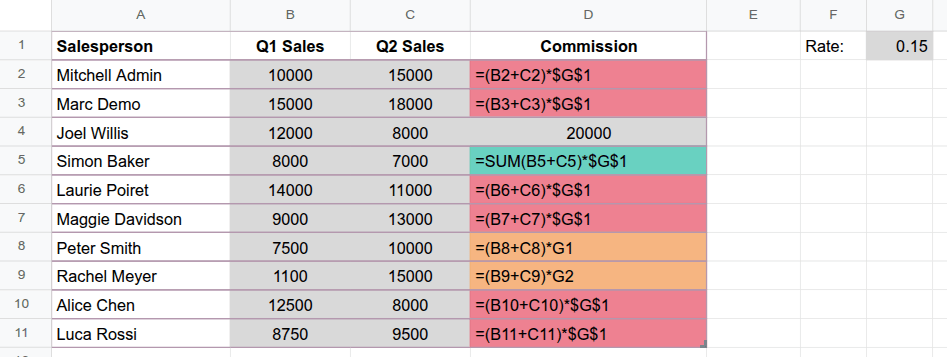
In the example (in which the formulas have been made visible by selecting from the menu bar), column D contains the amount of commission earned over the first and second quarters. This is calculated by adding the sales of the two quarters, shown in columns B and C, then multiplying it by the bonus rate in cell G1.
The irregularity map identifies the patterns in the formulas in column D. Cells that follow the pattern of the initial formula used in cell D2 have the same red color, while the following anomalies are highlighted separately:
Cell D4: This cell features a static value instead of the formula.
Cell D5: The formula in this cell does not follow the pattern of the initial formula.
Cells D8 and D9: Cell D8 is missing the absolute reference (
$) onG1; when the formula is dragged to cell D9, this creates a referencing error because cell G2 is empty. As the formulas in the two cells follow the same pattern, they share the same color.