기본 외주 전반
In basic subcontracting, a company’s product is produced entirely by a subcontractor. The product is first purchased from the subcontractor, who acquires their own components, manufactures the final product, then delivers the final product to the contracting company’s warehouse.
The following documentation covers how to configure a subcontracted product and trigger the subcontracting process.
환경설정
To use subcontracting, contractors must first configure products with a vendor pricelist as well as a subcontracting-type BoM.
The pricelist allows the contracting company to purchase the product from the vendor (subcontractor) through a PO, while the BoM allows the product to be manufactured externally by the subcontractor.
품목 공급업체 환경설정
제품의 공급업체를 기본 하청 방식으로 설정하려면으로 이동하세요. 그런 다음 제품을 선택하거나 새로 만드세요.
On the product form, click the Purchase tab and add the product’s subcontractor as a vendor by clicking Add a line. Select the subcontractor in the Vendor drop-down menu.
Then, enter the price of the product in the Price field.
Finally, set a lead time for the product in the Delivery Lead Time field to specify the number of days for the subcontractor to produce and deliver the final product.
참고
Since contractors are only responsible for purchasing and receiving the final product, they do not need to additionally configure manufacturing lead times on a BoM. Instead, provide only a single Delivery Lead Time on the vendor pricelist that factors in both the subcontractor’s manufacturing and delivery time.
자재명세서 환경설정
After specifying the vendor, configure a subcontracting-type BoM for the product. Click the Bill of Materials smart button on the product form. Then, select the desired BoM or create a new one.
팁
또는로 이동하여 하청 제품의BoM를 선택합니다.
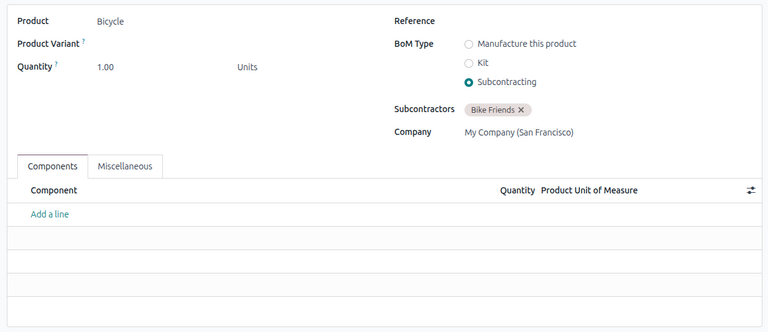
BoM 유형필드에서하청을 선택하세요. 표시되는하청업체필드에 하나 이상의 하청업체를 추가하세요.
Because the components and manufacturing are both handled by the subcontractor, there is no need to list any components in the Components tab of the BoM.
기본 외주 워크플로우
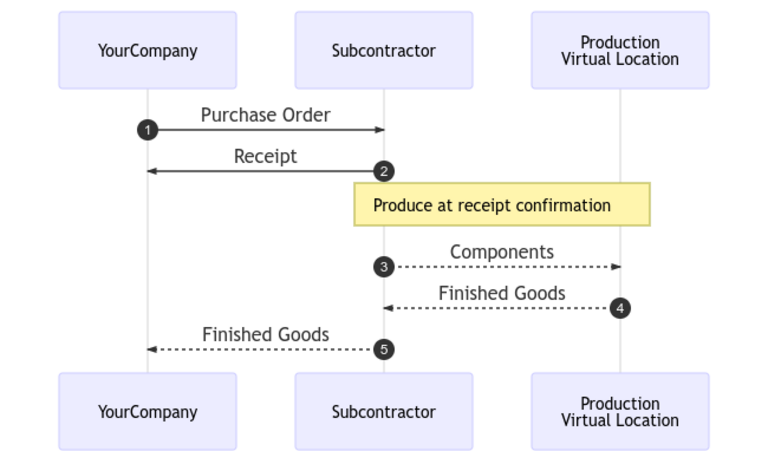
기본 하청 워크플로우는 하청업체로부터 제품을 매입하기 위해PO를 생성하는 것으로 시작합니다 (1).
The contractor (YourCompany) then confirms the PO, which creates a receipt to transfer the final product (2). The subcontractor manufactures the product and delivers it back to the contractor when done.
Once the product has been produced and received, the contractor validates the receipt (5) to trigger inventory moves from the subcontractor to the company’s stock (3, 4).
PO 생성 및 확인
하청 제품에 대한PO를 생성하려면으로 이동하여새로 만들기를 클릭하세요.
공급업체드롭다운 메뉴에서 하청업체를 선택하여PO작성을 시작하세요.제품탭에서제품 추가를 클릭하여 새 제품 라인을 만드세요.제품필드에서 하청 제품을 선택하고수량필드에 수량을 입력하세요.
After adding the product, the Expected Arrival field is updated with the finished product’s expected delivery date, as configured earlier with the vendor’s Delivery Lead Time.
마지막으로주문 확인을 클릭하여PO를 확인하세요. 입고가 자동으로 생성되고 양식 상단에입고스마트 버튼이 나타납니다.
입고 처리
After the order is confirmed, the subcontractor manufactures the product and delivers the finished good back to the contracting company.
To receive the finished product from the subcontractor, click the Receive Products button on the PO, or click the Receipt smart button at the top of the page. Then, click Validate to enter the incoming shipment into inventory.
참고
다단계 재고 흐름이 활성화된 경우 입고 제품을 재고에 입력하려면 추가 이전을 확인해야 합니다.
재고 이동 내역 추적
After validating a receipt, Odoo automatically generates inventory moves to track the movement of subcontracted products between locations. To view these inventory moves, navigate to .
To track inventory movement in subcontracting, Odoo sends any product components to a dedicated Subcontracting Location. A virtual location called Production then consumes the components and produces the finished good. Once produced, the good then moves back to the Subcontracting Location before finally entering the contractor’s stock when the receipt is validated.
참고
Because no components are sent in basic subcontracting, there is no movement from the Subcontracting Location to the Production location.