
Service rental products
The Rental app is a comprehensive tool that enables users to customize scheduling, pricing, and inventory for both physical rental products and non-physical goods (services) within a single platform. This flexibility allows for combining products and services like bike rentals with guided tours, or booking a studio with a photographer.
This document covers how to configure a rental service to automatically sync with staff shifts, track time sheet hours, and create project tasks based on a rental order.
Settings
To configure default settings on rental products, navigate to .
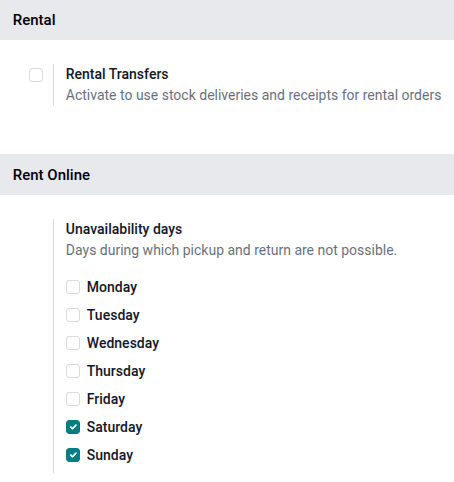
In the Rental section, enable Rental Transfers. In the Rent Online section, designate Unavailability days.
Click Save to apply the changes.
App integration configuration
The following apps are essential for workflow efficiency and automation when creating a service product and rental order:
Sales app: Enables the Prices tab, the use of pricelists, online payments, and quotation templates within the Rental app.
Sign app: Allows for the upload and customization of different rental and service agreements. These documents are used to facilitate the Request Signature feature.
Project app: Enables the automation of creating projects and tasks whenever a rental order is confirmed through the configuration on the rental product form.
Planning app: Enables the automation of matching rental orders with services with employee shifts based on availability.
Timesheet app: Allows employees to log time worked on tasks that are automatically created when confirming a rental order.
eCommerce app: Allows rental products and services to be rented directly from the website.
View rental services
To view all products that can be rented in the database, navigate to . By default, the Rental filter appears in the search bar, and the view is Kanban. Remove the filter, then click the search bar. From the preset filters, select Services. All the configured services appear.
Each service product Kanban card displays the service name, rental rate, and product image (if applicable).
Create a new service product
Important
The Project, Planning, and Sales apps must be installed for the following options to be available on the product form:
Create on Order
Project Template
Invoicing Policy
Project & Task
Planning Services
The Sales checkbox enables the Create on Order and Invoicing Policy fields and also the Prices tab.
To set up a new rental service, go to the and then click New. In the new product window, the Sales checkbox is enabled by default.
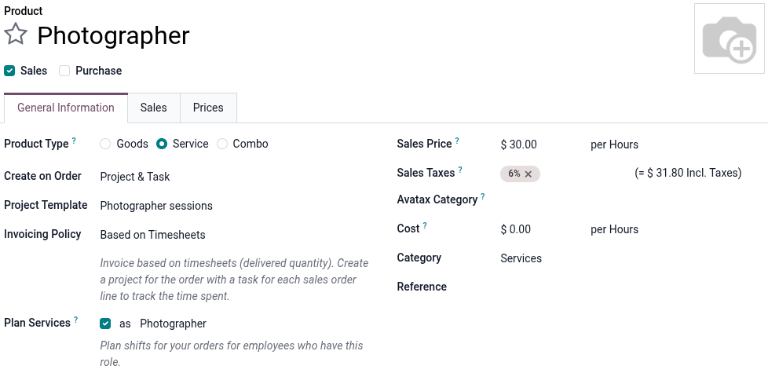
Set the Product Type as Service. In the Create on Order drop-down menu, select Project & Task, then select a template for the Project Template field. In the Invoicing Policy drop-down menu, select Based on Timesheets.
Tick the Plan Services checkbox and either create a new role or select a pre-existing one. To create a new role, type in the name of the role in the blank field and click Create and edit that appears.
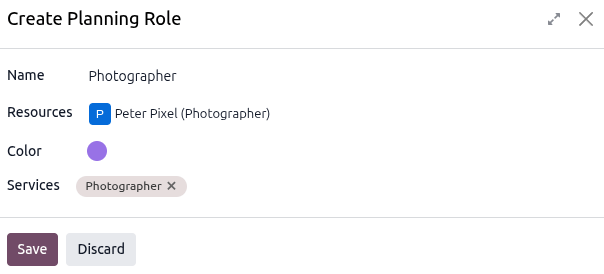
In the Create Planning Role pop-up window, enter the role’s name. Select an option for the Services and Resources, and click Save.
Set a base rental period and price
Set up a base rental rate by entering the lowest rental price in the Sales Price field. Next, click the Sales tab, then in the Rental section, select the Periodicity (the unit of duration of the rental) from the dropdown menu.
Then enter the Padding Time to make the product unavailable for pick up for the configured duration.
Important
To set a pricelist for additional rental rates, the Sales app must be installed, and Pricelists must be enabled. Otherwise, the Prices tab is not available.

Set additional rental periods and pricing
There are two ways to configure additional rental rates in the Rental app: Pricelists and the Prices tab.
Using the Pricelists method
Creating a new Pricelist allows for better customization when applying rental rates to specific time periods, products, or customers by using Pricelist Rules. To set up additional rental rates, go to and click New to create a new pricelist. A Create Pricelist Rules window displays.
Tip
It is recommended to create a new Pricelist first, then select the customized Pricelist in the Prices tab instead of using the Default pricelist. Keeping the Default pricelist blank ensures there is a clean pricelist for the base rental rate.
Example
Part 1
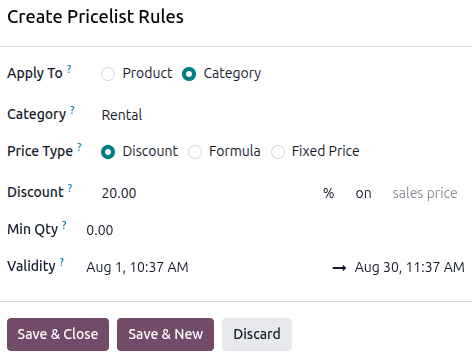
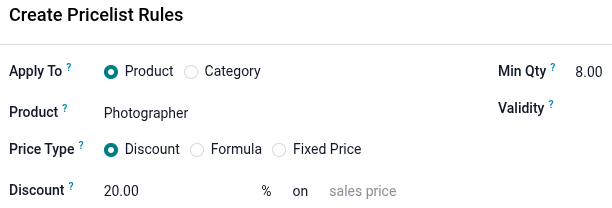
A photography studio rents out its photographers on an hourly and daily basis. The hourly rate is $30, but the studio offers a 20% discount for all-day sessions (eight hours or more). All reservations require a 24-hour notice to reserve a photographer. Navigate to and click the desired product.
Enter the Sales Price and then click the Sales tab to configure the Periodicity and the Padding Time.

Using the Pricelist method, navigate to and click New. Configure Pricelist Rules for the daily rate.
Using the Prices tab method
Prices can also be configured directly on the product using the Prices tab. Navigate to , then click the desired product.
Click the Prices tab and click Add a price. Select the desired Pricelist, then enter the minimum time required for the price change to trigger in the Min. Quantity column. The Min. Quantity column is based on the Periodicity field in the Sales tab.
Lastly, enter the Price rate. Click the (Save manually) icon near the top to save.
Example
Part 2
Using the same scenario in the Pricelists method example, use the Prices tab method by navigating to and click the desired product to configure. Click the Prices tab and configure a new daily rate.

Create a rental order with a service product
In Odoo, a rental order is the same as a sales order. When creating orders in the Rental app, they are referred to as rental orders.
Navigate to the Rental app, which opens the Rental Orders dashboard. Click New to open a new rental order form.
Enter the Customer field, and select a Quotation Template, if applicable.
To adjust the rental duration, click the first date in the Rental period field, and select the range of dates and times to represent the rental duration from the pop-up calendar form that appears.

Once complete, click Apply in the calendar pop-up form. Next, add a rental service in the Order Lines tab by clicking Add a product and selecting the desired rental service to add to the form. Enter the desired amount in the Quantity column.
Note
If a rental product is added before the Rental period field has been configured, the user can still adjust it accordingly.
Select the desired date range to represent the rental duration, then click Update Rental Prices.

Odoo recalculates the rental price accordingly.

Once all information has been entered correctly on the rental order form, click Send to email the quotation to the customer. When the customer approves the quotation, click Confirm. A status banner displays on the rental order.
Request a customer signature
Before the date of the service, Odoo can request that the customer sign a service agreement. Service agreements detail the business relationship and mutual duties. These agreements protect both the provider and the customer by creating clear, enforceable guidelines.
Note
The customer signature can be requested during any stage of the order. This feature also requires the Sign app.
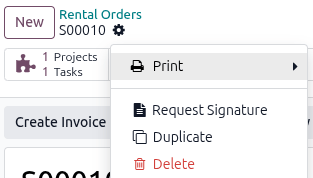
To request a signature, open the Rental app and select the desired rental order. Click the (Actions) icon, then click Request Signature.
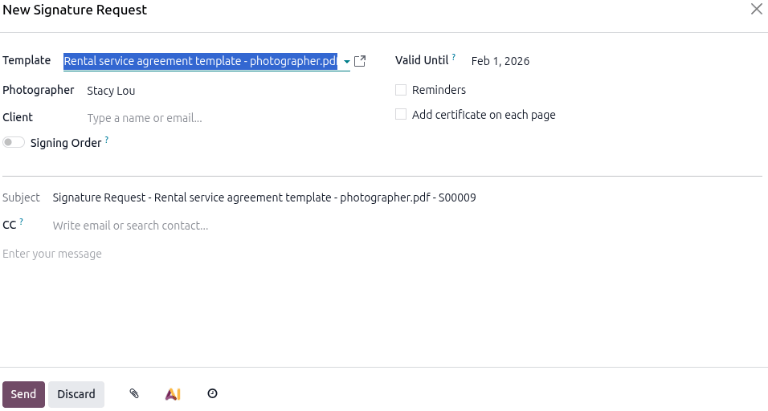
A New Signature Request pop-up window displays. Select the desired document from the Template drop-down menu.

Doing so reveals another New Signature Request pop-up window. Confirm the information in the New Signature Request pop-up window, then click Send to initiate the signing process.
A link to the signature request will appear in the chatter of the rental order. The document is accessible to the customer via the customer portal or email.
Tip
If the agreement is configured to require a signature from the rental company, a Sign Now button displays on the pop-up window. The user can add a signature via the Sign app integration before sending it to the customer.
A link to the signature request will appear in the Chatter. The document is accessible to the customer via the customer portal or email.
Signing a document from an email link
When a customer clicks Sign document, a separate page is then revealed, showcasing the document to be signed. The customer begins the process by clicking Click to start.
The app guides the signer to the required signature locations and allows them to create electronic signatures to complete the form.

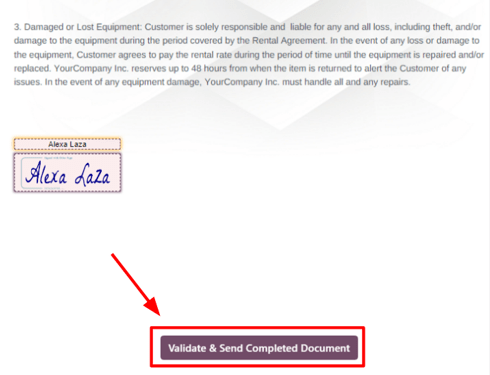
Once the document has been signed and completed, click Validate & Send Completed Document at the bottom of the document. The signed document can be downloaded for record-keeping purposes, if necessary.
See also
Managing the project created from the rental order
Important
For the appropriate smart buttons to display, the Project, Timesheet, Planning, and Inventory apps are needed. The selected service product on the rental order must be properly configured to integrate with the recommended apps.
When the rental order is confirmed, the following smart buttons appear at the top:
Tasks: Linked to the Projects app and show any projects or tasks related to the rental order.
Recorded: Linked to the Timesheets app and shows how many hours are related to the rental order.
Planned: Linked to the Planning app and shows how many hours are related to the rental order.
Delivery: Linked to the Inventory app and shows any delivery and receipt orders related to the rental order.
Click the Tasks smart button to view a Kanban view of all the associated tasks that were automatically created when confirming the rental order. Customize the tasks in the project as needed.
Tip
Configuring the use of Project templates on the product form creates new projects with predefined tasks, priority levels, and assigned employees.
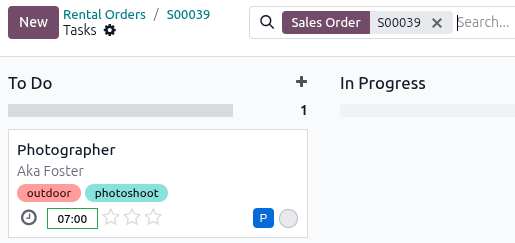
Managing employee shifts for rental services
Confirmed rental orders containing service products trigger the automatic creation of shifts. These shifts are generated for the assigned employee role when the availability matches the designated rental period. This automation is made possible by the integration with the Planning app and the configuration of the service product.
Click the Planned smart button to see a Gantt view of all the open shifts and shifts for the associated role that are available for the rental period of the rental order. Customize the shifts as needed.
Tip
Project templates allow for automated task assignment. When integrated with the Planning app, the system automatically schedules and publishes an employee’s shift if their availability matches the rental period. Priority is given to employees with the relevant roles if applicable.

Enter time for the rental service
To set the allocated time for a task to match the rental period, click the respective service product task, then in the Allocated Time field, enter the number of hours ordered.
To enter time worked on a service product, select the respective service task, then click the Timesheets tab. Click Add a line to enter the:
Date: The date the work was performed.
Employee: The employee who performed the work.
Description: A brief description of the work performed.
Time Spent: The number of hours worked on the task for that entry.
Click on the Sales Order smart button to return to the rental order.
Note
Once time is added to the Timesheets tab of a task, the status of the rental order is automatically changed to Picked-up, and the Return button appears.

Tracking delivered time on a rental order
When time is entered on the Timesheets tab of an associated task, the delivered time is automatically tracked on the rental order.
To view the delivered time, navigate to the desired rental order and click the Recorded smart button at the top of the rental order. The total hours worked appear in the Recorded Time field.

Process a rental order pickup
When a product is rented alongside a service, it is advised to pick it up before entering time on the associated task.
If time is entered on the Timesheets tab of an associated task before the physical rental product is picked up, the rental order status automatically changes to Picked-up. The Pickup button is still available on the rental order if time is entered before picking up the product.
When a customer picks up the product, navigate to the appropriate rental order and click Pickup. Verify the list, then click Validate in the Validate a pickup pop-up window that appears.
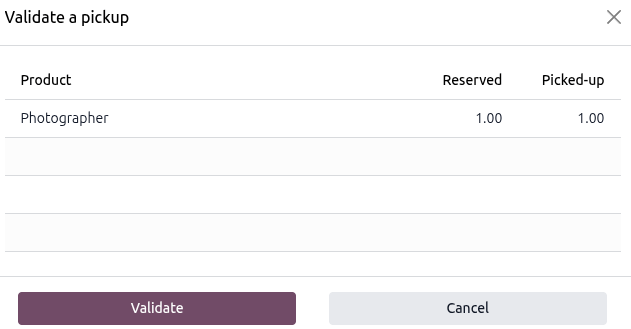
Doing so places a Picked-up status banner on the rental order.
Process a rental order return
Regardless of whether there is a product rented along with a service, the service or product must be returned on the rental order.
When a customer returns the products or when the service has been completed, navigate to the appropriate rental order and click Return. Validate the return by clicking Validate in the Validate a return pop-up window that appears.
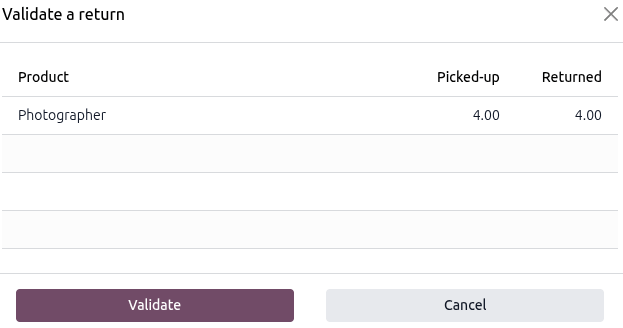
Doing so places a Returned status banner on the rental order.
Example
The photography studio had a customer who wanted to rent one of their photographers and banner decorations for a home photo shoot. The booking was for two hours.
On the Validate a return form for rental order, the banner line item matches the number of banners picked up, and the photographer line item matches the number of hours submitted on the Timesheets tab on the related task.
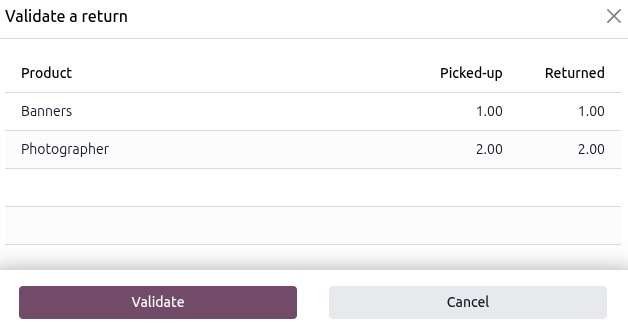
Create an invoice
It is typical for service-based businesses to invoice customers for services rendered. In the context of rental orders, this means creating an invoice for the services provided, such as a photographer or event staff.
Navigate to the desired invoice by opening the app and landing on the Rental Orders dashboard. Click To Invoice in the Invoice Status section to view all rental orders that require invoices to be sent.
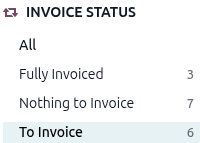
Click on the desired rental order Any information in the sales order’s columns that are blue is available to be invoiced.

Click Create Invoice. Select Regular invoice from the Create invoice(s) window and click Create Draft.
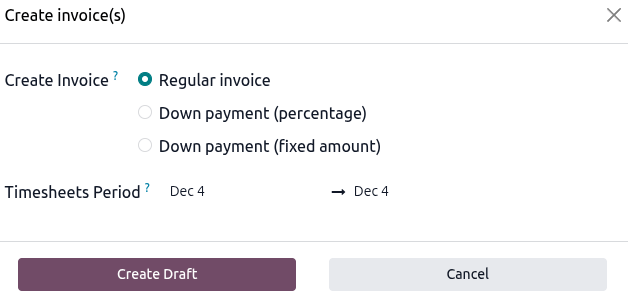
If all the details are correct, click Confirm and then Send to email the invoice to the customer. For in-person transactions, click Print and then click Pay.
In the Pay pop-up window, select a Journal and click Create Payment.
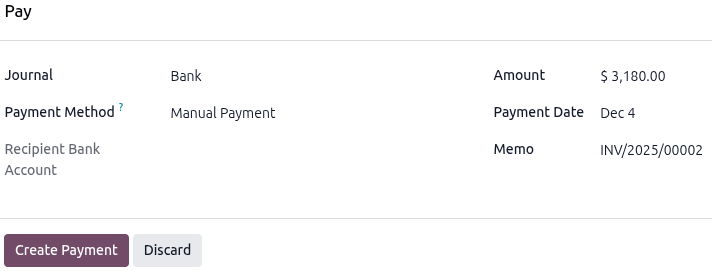
Click the Payments smart button at the top of the rental order. Click Validate to complete the payment.
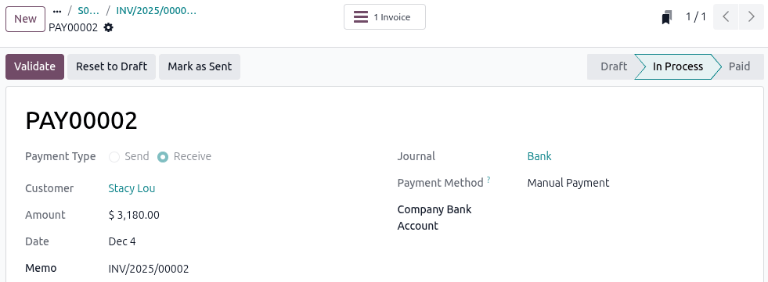
Use the breadcrumbs to return to the rental order.