
Cuti
Aplikasi Cuti Odoo berfungsi sebagai pusat terpusat untuk semua informasi terkait cuti. Aplikasi ini mengelola permintaan, saldo, alokasi, persetujuan, dan laporan.
User dapat meminta cuti, dan melihat ikhtisar permintaan dan saldo cuti mereka. Manajer dapat mengalokasikan cuti kepada individu, tim, atau seluruh perusahaan, dan menyetujui permintaan cuti.
Detailed reports can be run to see how much time off (and what kinds of time off) are being used, accrual plans can be created, and public holidays can be set.
Catatan
Harap diperhatikan, hanya user dengan hak akses tertentu yang dapat melihat semua aspek aplikasi Cuti.
Semua user dapat mengakses bagian My Time Off dan Overview dari aplikasi Cuti. Semua bagian lainnya memerlukan hak akses tertentu.
To better understand how access rights affect the Time Off app, refer to the Karyawan baru document, specifically the section about configuring the work information tab.
Konfigurasi
Untuk mengalokasikan cuti kepada karyawan, dan agar karyawan dapat meminta dan menggunakan cuti mereka, berbagai jenis cuti harus dikonfigurasi terlebih dahulu, kemudian dialokasikan kepada karyawan (jika alokasi diperlukan).
Jenis cuti
Untuk melihat jenis cuti yang saat ini dikonfigurasi, navigasikan ke . Jenis cuti ditampilkan dalam tampilan daftar.
The Time Off app comes with four preconfigured time off types: Paid Time Off, Sick Time Off, Unpaid, and Compensatory Days. These can be modified to suit business needs, or used as-is.
Buat jenis cuti
Untuk membuat jenis cuti baru, navigasikan ke . Dari sini, klik tombol Baru untuk menampilkan formulir jenis cuti kosong.
Enter the name for the particular type of time off in the blank line at the top of the form, such as
Sick Time or Vacation. Then, enter the following information on the form.
Catatan
Satu-satunya kolom wajib pada formulir jenis cuti adalah nama Jenis Cuti, Ambil Cuti Dalam, dan Jenis Cuti. Selain itu, bagian Permintaan Cuti dan Permintaan Alokasi harus dikonfigurasi.
Time Off Requests section
Persetujuan: pilih jenis persetujuan spesifik yang diperlukan untuk jenis cuti. Pilihannya adalah:
Tanpa Validasi: Tidak diperlukan persetujuan saat meminta jenis cuti ini. Permintaan cuti disetujui secara otomatis.
Oleh Petugas Cuti: Hanya Petugas Cuti yang ditentukan, yang diatur pada formulir ini di kolom Petugas Cuti yang Diberitahu, yang diperlukan untuk menyetujui permintaan cuti. Opsi ini dipilih secara default.
Oleh Pemberi Persetujuan Karyawan: Hanya pemberi persetujuan karyawan yang ditentukan untuk cuti, yang diatur pada tab Informasi Kerja pada formulir karyawan, yang diperlukan untuk menyetujui permintaan cuti.
By Employee's Approver and Time Off Officer: Both the employee's specified time off approver and the Time Off Officer are required to approve the time off request.
Allocation Requests section
Memerlukan alokasi: Jika cuti harus dialokasikan kepada karyawan, pilih Ya. Jika cuti dapat diminta tanpa cuti sebelumnya dialokasikan, pilih Tanpa Batas. Jika Tanpa Batas dipilih, opsi berikut tidak muncul pada formulir.
Permintaan Karyawan: Pilih Permintaan Hari Tambahan Diizinkan jika karyawan dapat meminta lebih banyak cuti daripada yang dialokasikan.
Jika karyawan tidak boleh membuat permintaan untuk lebih banyak cuti daripada yang dialokasikan, pilih opsi Tidak Diizinkan.
Example
Sepuluh hari dialokasikan kepada karyawan untuk jenis cuti tertentu ini, dan opsi Permintaan Hari Tambahan Diizinkan diaktifkan. Karyawan ingin mengambil liburan selama dua belas hari. Mereka dapat mengajukan permintaan untuk dua hari tambahan, karena opsi Permintaan Hari Tambahan Diizinkan diaktifkan.
Penting
Penting untuk dicatat bahwa meminta cuti tambahan tidak menjamin bahwa cuti akan diberikan.
Approval: Pilih jenis persetujuan yang diperlukan untuk alokasi jenis cuti ini.
Approved by Time Off Officer indicates the Time Off Officer set on this form must approve the allocation.
No validation needed indicates that no approvals are required.
Bagian konfigurasi
Notified Time Off Officer: Select the person who is notified and responsible for approving requests and allocations for this specific type of time off.
Take Time Off in: Select the format the time off is requested in from the drop-down menu.
Opsinya adalah:
Hari: jika cuti hanya dapat diminta dalam kelipatan hari penuh (8 jam).
Setengah Hari: jika cuti hanya dapat diminta dalam kelipatan setengah hari (4 jam).
Jam: jika cuti dapat diambil dalam kelipatan per jam.
Deduct Extra Hours: Aktifkan opsi ini jika permintaan cuti harus memperhitungkan waktu ekstra yang diperoleh karyawan.
Example
Jika karyawan bekerja dua jam ekstra untuk minggu tersebut, dan meminta lima jam cuti, permintaan akan menjadi tiga jam, karena dua jam kerja ekstra digunakan terlebih dahulu, dan dikurangkan dari permintaan.
Izinkan Melampirkan Dokumen Pendukung: Aktifkan opsi ini untuk mengizinkan karyawan melampirkan dokumen pada permintaan cuti. Ini berguna dalam situasi di mana dokumentasi diperlukan, seperti cuti medis jangka panjang.
Jenis Cuti: Dari menu drop-down, pilih jenis cuti, baik Waktu Kerja atau Ketidakhadiran. Waktu Kerja menunjukkan bahwa cuti yang diambil dihitung sebagai waktu kerja untuk jenis akrual apa pun yang sedang dijalankan karyawan, sedangkan Ketidakhadiran tidak dihitung untuk jenis akrual apa pun.
Perusahaan: Jika beberapa perusahaan dibuat dalam database, dan tipe cuti ini hanya berlaku untuk satu perusahaan, pilih perusahaan dari menu drop-down. Jika field ini dibiarkan kosong, tipe cuti berlaku untuk semua perusahaan dalam database. Field ini hanya muncul dalam database multi-perusahaan.
Negative Cap section
Enable the Allow Negative Cap option if employees are able to request more time off than they currently have, allowing a negative balance. If enabled, an Amount in Negative field appears. In this field, enter the maximum amount of negative time allowed, in days.
Example
Sara saat ini memiliki tiga hari dari tipe cuti Vacation. Dia merencanakan perjalanan yang memerlukan lima hari cuti.
The Vacation time off type has the Allow Negative Cap option enabled, and the
Amount in Negative is set to five.
Pengaturan ini memungkinkan Sara untuk mengajukan permintaan lima hari untuk jenis cuti Vacation. Jika disetujui, saldo cuti Vacation miliknya akan menjadi negatif dua (-2) hari.

Bagian payroll
Jika tipe cuti harus membuat Entri-entri kerja dalam aplikasi Payroll, pilih Tipe Entri Kerja dari daftar drop-down.
Bagian timesheet
Catatan
Bagian Timesheet hanya muncul jika user berada dalam mode pengembang. Lihat dokumen Mode pengembang (mode debug) untuk detail tentang cara mengakses mode pengembang.
Ketika karyawan mengambil cuti, dan juga menggunakan timesheet, Odoo membuat entri dalam aplikasi Timesheet untuk cuti tersebut. Bagian ini menentukan bagaimana entri tersebut dimasukkan.
Project: Pilih project di mana entri tipe cuti muncul.
Tugas: Pilih tugas yang muncul dalam timesheet untuk tipe cuti ini. Opsi default adalah: Cuti, Rapat, atau Pelatihan.
Display Option section
Color: Pilih warna yang akan digunakan di dashboard aplikasi Time Off.
Cover Image: Pilih ikon yang akan digunakan di dashboard aplikasi Time Off.

Rencana akrual
Beberapa cuti diperoleh melalui rencana akrual, yang berarti bahwa untuk setiap jumlah waktu tertentu karyawan bekerja (jam, hari, minggu, dll), mereka mendapatkan atau mengakrualkan jumlah cuti tertentu.
Example
Jika karyawan mengakrualkan satu hari liburan untuk setiap minggu mereka bekerja, mereka akan mendapatkan 0,2 hari liburan untuk setiap jam mereka bekerja. Pada akhir minggu kerja 40 jam, mereka akan mendapatkan satu hari liburan penuh (8 jam).
Buat rencana akrual
Untuk membuat rencana akrual baru, navigasikan ke . Kemudian, klik tombol Baru, yang menampilkan formulir rencana akrual kosong.
Masukkan informasi berikut pada formulir:
Nama: Masukkan nama rencana akrual.
Waktu Perolehan Akrual: Pilih kapan karyawan mulai mengakrualkan cuti, baik Pada awal periode akrual atau Pada akhir periode akrual.
Waktu Saldo Bawa: Pilih kapan karyawan menerima waktu yang diperoleh sebelumnya. Opsinya adalah:
At the start of the year: Pilih ini jika akrual diperpanjang pada 1 Januari tahun mendatang.
At the allocation date: Pilih ini jika akrual diperpanjang segera setelah waktu dialokasikan kepada karyawan.
Lainnya: Pilih opsi ini jika kedua opsi lainnya tidak berlaku. Ketika dipilih, field Tanggal Saldo Bawa muncul. Pilih tanggal menggunakan dua menu drop-down, satu untuk hari dan satu untuk bulan.
Berdasarkan waktu kerja: Aktifkan opsi ini jika akrual cuti ditentukan oleh jam kerja karyawan. Hari yang tidak dianggap sebagai waktu kerja tidak berkontribusi pada rencana akrual di Odoo.
Example
An employee is granted time off from an accrual plan configured to accrue one day of vacation for every five days worked. The accrual plan is based on the employee's worked time (the Based on worked time checkbox is ticked).
Karyawan bekerja minggu standar 40 jam. Menurut rencana akrual, mereka harus mendapatkan empat hari liburan per bulan.
The employee takes five days off. The time off type the employee has taken has the Kind of Time Off configured as an Absence.
Since the accrual plan only grants time off based on the worked time, the employee does not accrue a vacation day for the five days of time off that is considered an absence.
At the end of the month, the employee accrues only three days, instead of four.
Transisi Pencapaian: Bidang ini hanya terlihat setelah minimal dua aturan telah dikonfigurasi pada rencana akrual. Pilihan ini menentukan kapan karyawan naik ke pencapaian baru. Jika mereka memenuhi syarat untuk mengubah pencapaian di tengah periode pembayaran, putuskan apakah karyawan mengubah pencapaian Segera atau Setelah periode akrual ini (setelah periode pembayaran saat ini).
Company: This field only appears in a multi-company database. Using the drop-down menu, select the company the accrual plan applies to. If left blank, the accrual plan can be used for all companies.

Aturan
Aturan harus dibuat agar karyawan dapat mengakrualkan cuti dari rencana akrual.
Untuk membuat aturan baru, klik tombol Pencapaian Baru di bagian Aturan abu-abu, dan formulir modal Buat Pencapaian akan muncul.
Isi bidang berikut pada formulir:
Karyawan mengakrualkan: Pilih parameter untuk cuti yang diperoleh di bagian ini.
Pertama, pilih Hari atau Jam untuk penambahan waktu yang diakrualkan menggunakan menu drop-down.
Selanjutnya, masukkan jumlah numerik dari parameter yang dipilih yang diakrualkan. Format numeriknya adalah
X.XXXX, sehingga hari atau jam parsial juga dapat dikonfigurasi.Terakhir, pilih seberapa sering waktu diakrualkan menggunakan menu drop-down. Opsi defaultnya adalah Per Jam, Harian, Mingguan, Dua kali sebulan, Bulanan, Dua kali setahun, dan Tahunan.
Tergantung pada opsi mana yang dipilih, bidang tambahan mungkin muncul. Misalnya, jika Dua kali sebulan dipilih, dua bidang tambahan muncul, untuk menentukan dua hari setiap bulan pencapaian terjadi.
Cap accrued time: If there is a maximum amount of days the employee can accrue with this plan, enable this option.
When enabled, two additional fields appear beneath it. Select the type of time period from the drop-down menu, either Days or Hours.
Then, enter a numerical value in the field to specify the maximum amount of time that can be accrued.
Milestone reached: Enter the number and value of the time period that must pass before the employee starts to accumulate time off. The first value is numerical; enter a number in the first field.
Then, select the type of time period using the drop-down menu in the second field. The options are: Days, Months, or Years.
Pemindahan: pilih bagaimana sisa cuti yang tidak digunakan ditangani. Opsinya adalah:
None. Accrued time reset to 0: Any unused time off is gone.
Semua waktu yang diakrualkan dipindahkan: Semua cuti yang tidak digunakan dipindahkan ke tahun kalender berikutnya.
Carry over with a maximum: Unused time off is rolled over to the next calendar year, but there is a cap. An Up to field appears if this is selected. Enter the maximum number of Days that can roll over to the following year. Any time off beyond this parameter is lost.
Penting
Jika bidang Pemindahan diatur ke Tidak ada. Waktu yang diakrualkan direset ke 0, aturan tersebut menimpa Waktu Pemindahan yang diatur pada rencana akrual.
Jika perusahaan membuat rencana akrual, memberikan karyawan cuti Pada awal periode akrual (yaitu, awal tahun), dan mengatur Waktu Pemindahan pada rencana akrual ke Pada awal tahun, hal ini memungkinkan waktu liburan yang tidak digunakan untuk dipindahkan ke tahun berikutnya.
Kemudian, perusahaan menambahkan aturan ke rencana akrual, mengalokasikan lima hari liburan, setiap tahun, pada tanggal satu tahun (satu minggu liburan dialokasikan pada 1 Januari).
Jika bidang Pemindahan diatur ke Tidak ada. Waktu akrual direset ke 0 pada pop-up Buat Pencapaian, waktu liburan yang tidak digunakan tidak dipindahkan, meskipun pada formulir Rencana Akrual, Waktu Pemindahan diatur ke Pada awal tahun.
Pemindahan yang diatur pada aturan lebih diutamakan daripada pemindahan yang diatur pada formulir rencana akrual.
Setelah formulir selesai, klik Simpan & Tutup untuk menyimpan formulir Buat Pencapaian dan menutup modal, atau klik Simpan & Baru untuk menyimpan formulir dan membuat pencapaian lain. Tambahkan sebanyak mungkin pencapaian yang diinginkan.

Tanggal merah
To observe public or national holidays, and provide extra days off as holidays to employees, configure the observed public holidays in Odoo.
It is important to configure these days in Odoo, so employees are aware of the days they have off, and do not request time off on days that are already set as a public holiday (non-working days).
Selain itu, semua hari libur umum yang dikonfigurasi di aplikasi Cuti juga tercermin di aplikasi apa pun yang menggunakan jadwal kerja, seperti Kalender, Perencanaan, Manufaktur, dan lainnya.
Karena integrasi Odoo dengan aplikasi lain yang menggunakan jadwal kerja, dianggap praktik terbaik untuk memastikan semua hari libur umum dikonfigurasi.
Create public holiday
To create a public holiday, navigate to .
All currently configured public holidays appear in a list view.
Klik tombol Baru, dan baris baru muncul di bagian bawah daftar.
Masukkan informasi berikut pada baris baru tersebut:
Name: Masukkan nama hari libur.
Company: Jika dalam database multi-perusahaan, perusahaan saat ini mengisi field ini secara default. Tidak mungkin untuk mengedit field ini.
Catatan
The Company field is hidden, by default. To view this field, click the (additional options) icon in the top-right corner of the list, to the far-right of the column titles, and activate the Company selection from the drop-down menu that appears.
Start Date: Using the date and time picker, select the date and time the holiday starts, then click Apply. By default, this field is configured for the current date. The start time is set according to the start time for the company (according to the working schedules). If the user's computer is set to a different time zone, the start time is adjusted according, compared to the company's time zone.
End Date: Using the date and time picker, select the date and time the holiday ends, then click Apply. By default, this field is configured for the current date, and the time is set to the end time for the company (according to the working schedules). If the user's computer is set to a different time zone, the start time is adjusted accordingly, compared to the company's time zone.
Example
Perusahaan yang berlokasi di San Francisco beroperasi dari pukul 9:00 pagi - 6:00 sore, dengan hari kerja delapan jam dan istirahat makan siang satu jam.
Untuk user di New York, dengan zona waktu komputer diatur ke Eastern Standard Time, hari libur umum yang dibuat menampilkan waktu mulai pukul 12:00 PM - 9:00 PM, memperhitungkan perbedaan zona waktu tiga jam.
Demikian pula, user yang berlokasi di Los Angeles, dengan zona waktu komputer diatur ke Pacific Standard Time, melihat waktu hari libur umum sebagai 9:00 AM - 6:00 PM.
Jam Kerja: Jika hari libur hanya berlaku untuk karyawan yang memiliki jam kerja tertentu, pilih jam kerja dari menu drop-down. Jika dibiarkan kosong, hari libur berlaku untuk semua karyawan.
Work Entry Type: If using the Payroll app, this field defines how the work entries for the holiday appear. Select the work entry type from the drop-down menu.

Hari wajib
Beberapa perusahaan memiliki hari khusus di mana departemen tertentu, atau seluruh staf, diwajibkan hadir, dan cuti tidak diizinkan pada hari-hari tertentu tersebut.
Jenis hari seperti ini disebut hari wajib di Odoo. Ini dapat dikonfigurasi untuk seluruh perusahaan, atau khusus departemen. Ketika dikonfigurasi, karyawan di departemen atau perusahaan yang ditentukan tidak dapat mengajukan permintaan cuti untuk hari wajib ini.
Buat hari wajib
Tidak ada hari wajib yang dikonfigurasi di Odoo secara default. Untuk membuat hari wajib, navigasikan ke .
Klik tombol New di pojok kiri atas, dan baris kosong muncul di daftar.
Masukkan informasi berikut pada baris baru tersebut:
Name: Masukkan nama hari wajib.
Company: Jika dalam database multi-perusahaan, field ini terlihat, dan perusahaan saat ini mengisi field ini secara default. Menggunakan menu drop-down, pilih perusahaan untuk hari wajib tersebut.
Departments: Kolom ini disembunyikan secara default. Pertama, klik ikon (additional options) di pojok kanan atas, di sebelah Color, lalu centang kotak di sebelah Departments untuk menampilkan kolom tersebut.
Selanjutnya, pilih departemen yang diinginkan dari menu drop-down. Beberapa departemen dapat dipilih, dan tidak ada batasan jumlah departemen yang dapat ditambahkan.
Jika field ini dibiarkan kosong, hari wajib berlaku untuk seluruh perusahaan.
Start Date: Menggunakan pemilih kalender, pilih tanggal dimulainya hari wajib.
End Date: Menggunakan pemilih kalender, pilih tanggal berakhirnya hari wajib. Jika membuat satu hari wajib, tanggal akhir harus sama dengan tanggal mulai.
Color: If desired, select a color from the available presented options. If no color is desired, select the
No coloroption, represented by a white box with a red line diagonally across it. The selected color appears on the main Time Off app dashboard, in both the calendar and in the legend.

Gambaran Umum
To view a color-coded schedule of the user's time off, and/or of the team managed by them, navigate
to . This presents a calendar with the default filter of
My Team, in a month view.
To change the time period displayed, click on the Month button to reveal a drop-down menu. Then, select either Day, Week, or Year to present the calendar in that corresponding view.
To navigate forward or backward in time, in the selected increment (Month, Week, etc.), click the ← (left arrow) or → (right arrow) to move either forward or backward in that specified amount of time.
For example, if Month is selected, the arrows adjust the view by one month.
To return to a view containing the current day, click the Today button at any time.
Anggota tim terdaftar secara alfabetis pada baris individual, dan cuti yang mereka minta, terlepas dari statusnya (divalidasi atau untuk disetujui), terlihat di kalender.
Setiap karyawan dikodekan dengan warna. Warna karyawan dipilih secara acak, dan tidak sesuai dengan jenis cuti yang mereka minta.
Status cuti diwakili oleh detail warna permintaan, baik tampak solid (divalidasi) atau bergaris (untuk disetujui).
Jumlah hari atau jam yang diminta ditulis pada permintaan (jika ada cukup ruang).
Di bagian bawah kalender, pada baris Total, grafik batang menunjukkan berapa banyak orang yang diproyeksikan cuti pada hari tertentu. Nomor pada setiap batang individual mewakili jumlah karyawan yang cuti untuk hari-hari yang disorot.
Klik entri cuti untuk melihat detail entri cuti tertentu. Total jumlah jam atau hari terdaftar, bersama dengan waktu mulai dan akhir cuti. Untuk melihat detail permintaan cuti dalam modal, klik tombol Lihat.
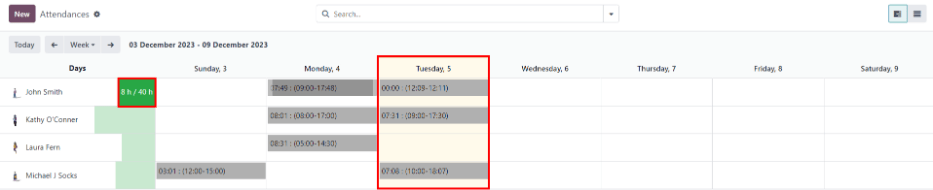
Laporan
The reporting feature allows users to view time off for their team, either by employee or type of time off. This allows users to see which employees are taking time off, how much time off they are taking, and what time off types are being used.
Any report can be added to a spreadsheet, when in either the (Graph) or (Pivot) view, through the Insert in Spreadsheet button that appears in the top-left of the report.
Catatan
Jika aplikasi Dokumen terinstal, opsi untuk menambahkan laporan ke spreadsheet akan muncul. Jika tidak, laporan dapat ditambahkan ke Dashboard.
Berdasarkan karyawan
To view a report of employee time off requests, navigate to .
Laporan default menampilkan data tahun berjalan dalam tampilan daftar, menampilkan semua karyawan dalam urutan abjad. Setiap baris karyawan diciutkan secara default. Untuk membuka baris, klik di mana saja pada baris tersebut.
Tampilan diperluas, dan memiliki permintaan cuti yang diatur berdasarkan jenis cuti. Klik di mana saja pada baris jenis cuti untuk memperluasnya, dan lihat semua permintaan cuti individual yang termasuk dalam jenis tersebut.
Informasi yang ditampilkan dalam daftar meliputi: nama Karyawan, Jumlah Hari cuti yang diminta, Tanggal Mulai, Tanggal Akhir, Status, dan Deskripsi.

Laporan juga dapat ditampilkan dengan cara lain. Klik tombol opsi yang sesuai di sudut kanan atas halaman untuk melihat data dengan cara tertentu. Berbagai opsi adalah (Daftar), atau tampilan default, (Grafik), tabel (Pivot), atau tampilan (Kalender).
When a selection has been made, additional options appear for that particular selection. For more detailed information on the reports and their various options, refer to the reporting documentation.
Berdasarkan jenis
To view a list of all time off, organized by time off type, navigate to . This shows all time off requests in a default bar chart.
Arahkan kursor ke batang untuk melihat Durasi (Hari) dari jenis cuti spesifik tersebut.

Klik pada batang untuk membuka tampilan daftar terperinci dari semua permintaan cuti untuk jenis cuti tersebut.
Setiap permintaan terdaftar, dengan informasi berikut yang ditampilkan: Karyawan, Jumlah Hari, Jenis Permintaan, Tanggal Mulai, Tanggal Akhir, Status, dan Deskripsi.
Laporan juga dapat ditampilkan dengan cara lain. Klik tombol opsi yang sesuai di sudut kanan atas halaman untuk melihat data dengan cara tersebut. Berbagai opsi adalah (Grafik) (tampilan default), (Daftar), atau tabel (Pivot).
When a selection has been made, additional options appear for that particular selection. For more detailed information on the reports, and their various options, refer to the reporting documentation.
Lihat juga