Introduction
This whitepaper is designed to help you understand the differences between leading project management applications: Odoo and Asana. It evaluates their ability to improve team coordination and streamline project task management. The document begins with a brief introduction to project management software, followed by an overview of the software landscape, a detailed functional comparison, and concluding insights.
Project management software:
Coordinating tasks and people
The modern practice of project management began with simple, manual tools. Whiteboards and sticky notes were the main means to track chunks of work (or “tasks”) that needed to be done. Graphical concepts like Gantt charts*, first used in the early 20th century, helped teams map out timelines and task dependencies. These early methods were highly visual and collaborative, but difficult to scale, share, or update efficiently.
With the rise of personal computers in the ‘80s and ’90s, digital project management took shape. Tools like Microsoft Project introduced dynamic scheduling, resource tracking, and budgeting features. While powerful, these early desktop-based tools were often very complex and required specialized training.
The 2000s marked a turning point with the arrival of cloud-based platforms like Jira and Basecamp. These tools emphasized ease of use, real-time collaboration, and visual task tracking, making project management more accessible to a wider range of teams and industries.
Today, modern project management software streamlines planning, communication, and execution. Solutions like Asana integrate task management, file sharing, timelines, and team coordination in one place, replacing the need for scattered tools and manual updates, and allowing teams to stay aligned.
* The Gantt chart is named after American engineer Henry Gantt, who popularized it in the early 20th century. However, a similar concept was originally developed in the late 19th century by Polish engineer Karol Adamiecki, who called it a harmonogram.
Beyond project management:
Connecting business operations
with broad-scope solutions
More and more businesses are turning to broad-scope, user-friendly platforms to streamline their entire operations. Solutions like Odoo go beyond traditional ERP functions such as order management and accounting, they also cover areas like project management and CRM, which are often managed using separate, specialized applications.
While tools like Asana have revolutionized project management by providing great user experience and functionality, similar innovations have emerged across other domains, CRM, marketing automation, website building, accounting, and more. Specialized applications often excel within their specific domain, but they fall short when it comes to cross-functional process integration and data sharing.
Organizations that over-rely on single-function apps find themselves with a patchwork of disconnected apps, each with its own subscription, updates, data sets, and integration challenges. This fragmented setup creates complexity, friction, and hidden costs, ultimately eroding the efficiency and agility these tools are meant to provide.
Modern, broad-scope platforms combine the usability and flexibility of specialized apps with embedded integration across all core business functions. By connecting project management with sales, finance, marketing, and HR, these solutions help businesses manage their processes end to end, reducing overhead, improving visibility, and enabling smarter, faster decision-making.
Odoo
Odoo is a comprehensive, open-core platform designed to revolutionize the business software landscape by providing a fully integrated suite of capabilities that streamline operations across departments. From accounting and CRM to project management and website, Odoo combines powerful features with a user-friendly interface in a single, unified system.
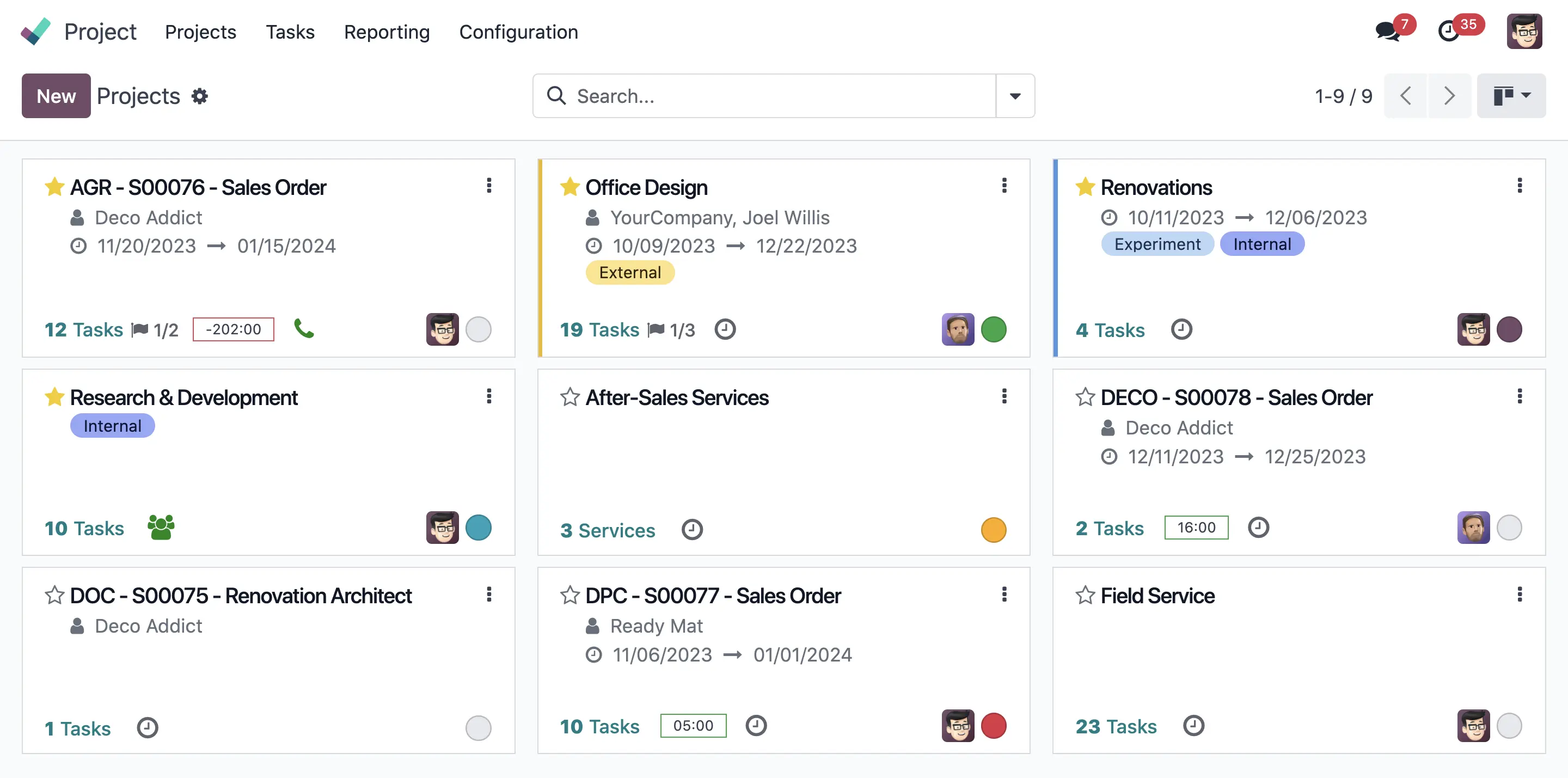
Odoo’s Project app delivers powerful capabilities through its intuitive interface. It offers multiple views (kanban, Gantt charts, calendars, and lists) to suit different preferences and needs. The built-in Chatter feature streamlines both internal communication and client interactions, while custom fields, advanced dashboards, and robust automation tools help teams stay focused on what matters most.
Thanks to its fully integrated design, Odoo offers thorough visibility and enables complete control over both sales activities and project finances. Prospect interactions, quotes, and customer orders are easily accessible through the Project and CRM apps, while built-in budget monitoring provides strong financial oversight. Invoicing is seamless as well, based on time, milestones, or both, Odoo supports flexible payment terms, including advance payments.
In short, Odoo simplifies business operations by replacing fragmented tools with a single, integrated platform, without sacrificing functionality or user experience. Its flexibility, automation, and all-in-one design make it a great choice for companies aiming to boost efficiency and gain end-to-end visibility across their workflow.
28 million +
users
44,000 +
apps
23,000 +
partners
8,000 +
employees
Asana
Asana is a work management tool that focuses on clarity and accountability. It is designed to help teams plan, organize, and track their work in one place. Asana allows users to manage tasks, projects, and workflows through multiple views including List, Board, Timeline (Gantt), and Calendar. Each task can include due dates, assignees, priorities, subtasks, comments, and file attachments to keep everyone aligned and informed.
Automation features, such as rules, templates, and forms, help streamline repetitive tasks and standardize workflows across teams. Asana also includes powerful reporting features, with real-time dashboards, workload tracking, and portfolio overviews for monitoring project progress and resource allocation. Built-in time tracking (on select plans) and integration with third-party time tracking tools support deeper productivity insights.
Asana integrates with over 200 popular apps, including Slack, Google Workspace, Microsoft Teams, Zoom, and more, allowing teams to connect their existing tools with minimal friction. Recently, Asana has introduced AI-powered features like AI teammates and an AI Studio, designed to automate planning and assist users with task generation, prioritization, and communication.
The bottom line is that Asana offers a flexible, scalable solution for managing tasks and projects across teams of any size. Its focus on collaboration, visibility, and automation, combined with a user-friendly interface and extensive integration options, makes it a valuable tool for organizations seeking to improve productivity and streamline operations.
170,000 +
paying customers
1
app
200 +
global partners
4,500 +
employees
Features Comparison
General
Odoo
Asana
Mobile Access
Automatic Task Assignment
Project-Specific Fields
Custom Branding
Autosave
Multiple Assignees
Quick Record Creation
Integrations with Other Modules
Third-Party Integrations
Customization
Flexible UI
Task Management
Odoo
Asana
Create Tasks (with titles, descriptions, etc.)
Create Subtasks
Assign Tasks to People
Track Task Completion and Status
Create Checklists within Tasks
Add Tags for Categorization
Mark Tasks as Dependent on Others
Set Reminders
Search and Filter Tasks
Track Time Spent on Tasks
Log Work Times Manually
Set Time Estimates for Tasks
Create Timesheet Reports
Advanced pricing package
Track Billable Hours
Batch Edit Multiple Tasks
Copy and Paste Tasks
Split Tasks
Percentage Completion on Tasks
Requires custom fields
Resource Planning
Cost Estimation per Task
Task Priority Levels
Gamification Elements
External Task Dependencies
Task Logging
Recurring Tasks
Task Delegation
Import/Export in Batches
Archive Tasks
Delete Tasks
Send SMS from Task
Send Emails from Task (on-task chat)
Share a Project Outside
Customizable Task Stages
Custom Fields
Access Rights on Tasks
Customizable Task Stages
Drag and Drop System
Color Coding
Add Followers on Tasks
Keyboard Shortcuts
Cover Image on Tasks
Click to Sign
Using Docusign integration
Templates & Automation
Odoo
Asana
Project Templates
Task Templates
Email Notifications Automation
Approved Quotes Trigger Full Project Plans
Webhooks
Task & Project Tracking
Odoo
Asana
Kanban View
Gantt Chart
List View
Calendar View
Graph View
Pivot table View
Milestones
Project Phases
Deadline Tracking
Employee Vacation Visibility
Task Creation from Email
Task Creation from Web Form
Google Form integration
Convert a Task to Ticket
Private Tasks
Filter Tasks by Teams
Timesheets
Task Creation from SO
SO Creation from Project
Time Remaining Display
Communication & Collaboration
Odoo
Asana
Chatter
Email Integration
Real-Time Collaboration
VoIP Integration
Integration with VoIP.ms via Zapier
Emoji Reactions
Customer Portal
Client Feedback Surveys & Analytics
Rich Text Editor
Custom Alerts
In-App Chat with Users
Schedule Meeting and Integrate with Video Conferencing
Add Internal Notes
Assign Followers to Tasks
Budgeting & Reporting
Odoo
Asana
Set Budget for Projects
Track Expenses
Define Cost Categories
Receive Budget Overrun Notifications
Track Project Revenue
Generate Reports
Create Custom Reports
Access Pre-Defined Dashboards
Analyze Project Expenses
Implement Earned Value Management
Real-Time Insights
Resource Reports
Predictive Analytics
Customizable Dashboards
Drill-Down Capabilities
Profitability Tracking
Analytic Accounts
Filter by Stages
Filter by Assignee
Filter by Tags
Filter by Deadline
Group by Option
View of Personal Tasks
Burndown Chart
Security & Access Control
Odoo
Asana
Two-Factor Authentification (2FA)
Data Encryption at Rest and in Transit
User Activity Audit Logs
Role-Based Access Control
Additional Features
Odoo
Asana
Generate Invoices Based on Timesheets (fixed price, milestones, time, and materials)
Track Changes Made to Tasks and Doc
Receive Notifications about Updates, Deadlines, and Mentions
Access in Multiple Languages
13 languages
Manage Project-Related Inventory
Integration with Manufacturing
Integration with CRM
paid add-on needed
Integration with Inventory
Integration with Accounting
paid add-on needed
Custom API Integrations
Calendar Integration
Email Integrations
Manage Project in Different Currencies
No automated conversion
Develop Custom Modules and Fields
Pricing & Conditions
Odoo
Asana
Monthly Pricing (per user)
Starting €19.9 | The standalone Project app is free
Starting $10.99 | A limited package for up to 10 people is free
Billing Term
Billed annually
Billed annually
Free Trial
30-day (all apps)
30-day
Free Upgrade
Upgrades to Future Versions
Hosting & Maintenance
Customer Support (Technical & Functional)
Rating
Odoo
Asana
Rating on g2Crowd
4.4/5.0 (Project app)
4.4/5.0
Rating on GetApp
4.2/5.0
4.5/5.0
Rating on Capterra
4.2/5.0
4.5/5.0
Different solutions, Different needs
When choosing the right software for your business, it is important to assess several criteria based on your specific needs.
Business scope measures a software’s ability to meet your comprehensive business needs through its features, customization options, and integration with other tools.
User-friendliness measures how straightforward and user-friendly a software solution is for your team to navigate, requiring minimal training or complex procedures. Additionally, it evaluates how hassle-free the software is to set up, considering factors like time, effort, and resource requirements for initial configuration within your organization.
For companies of any size looking to streamline project operations with seamless integration across their business, Odoo is a smart, scalable choice.
As a standalone project management tool, Odoo delivers a clean, intuitive interface that gives project teams full visibility into their work. Built-in automation and collaboration features help streamline workflows, while multiple task and project views, in-app email, timesheets, and calendar integration support day-to-day execution. Additionally, Odoo’s integrated dashboards provide managers with a clear project overview and help in identifying potential risks before they escalate.
But Odoo goes far beyond project management. As a true all-in-one platform, it seamlessly connects projects with sales, accounting, inventory, company website, and more, unlocking powerful efficiencies, especially for service-based businesses. With excellent value for money and easy implementation, it’s a compelling option, even for small businesses and startups. Odoo’s modular structure lets you start small, or even for free, and scale up as your needs grow.
That said, companies looking to transform their entire operations should be aware that a full Odoo implementation requires time, effort, and investment. Unlike narrow, single-purpose tools, a broad Odoo rollout requires a certain degree of commitment to change, but one that brings significantly greater long-term value.
If you're considering going beyond project management and unlocking your business’s full potential, Odoo is a powerful solution that can take you there.
Asana is known for its flexibility, clean design, and ease of use, making it a favorite for teams of all sizes looking to manage tasks and projects with minimal setup. Its intuitive interface and strong built-in features help teams stay organized and efficient from day one.
The software offers multiple project views, including lists, boards, timelines, and calendars, making it easy to adapt to different team preferences. It also includes robust automation features, task dependencies, and reusable templates to streamline workflows. One of Asana’s standout strengths is its extensive range of native integrations. With over 200 app connections, it allows for easy integration and data sync across various tools, such as Salesforce, Microsoft Teams, and Xero.
While Asana itself can be customized to act as a simple CRM using templates and custom fields, it lacks many core CRM features such as quote generation, pricing lists, lead scoring, and sales forecasting. Similarly, it offers no built-in budgeting functionality, any cost tracking must be handled manually via custom fields, with no true budget management or financial reporting out of the box.
Overall, Asana is a strong choice for teams focused on project coordination and collaboration. But businesses needing integrated sales, financial, or client management tools will likely need to pair it with other specialized solutions.
Conclusion
When it comes to project management, businesses have a wide range of tools to choose from, each tailored to different needs, functional scope, and team types. Whether you're a service-based business looking to centralize operations or a development team managing technical sprints, choosing the right platform depends on your business objectives.
Odoo is ideal for companies seeking tight integration between their project teams and broader operations. As an all-in-one platform, it links projects with various departments such as sales, accounting, and inventory. This connectivity makes it particularly beneficial for service-oriented businesses or companies managing projects that include tangible goods. While setup can require time and planning, Odoo’s modular structure and exceptional value for money make it accessible to both small businesses and growing enterprises.
Asana is great for teams that value simplicity, speed, and strong native integrations. It shines in task and workflow management with an intuitive interface and minimal learning curve. Though it can be adapted for lightweight CRM use, it lacks core CRM and budgeting features, making it better suited for execution rather than operations.
In summary, choosing the right tool is not always a straightforward decision. Odoo suits those seeking full operational integration. Asana is flexible, visually engaging platforms for teams needing structure and visibility.