Ir al contenido
Odoo Menú
  • Identificarse
  • Pruébalo gratis
  • Aplicaciones
    Finanzas
    • Contabilidad
    • Facturación
    • Gastos
    • Hoja de cálculo (BI)
    • Documentos
    • Firma electrónica
    Ventas
    • CRM
    • Ventas
    • TPV para tiendas
    • TPV para restaurantes
    • Suscripciones
    • Alquiler
    Sitios web
    • Creador de sitios web
    • Comercio electrónico
    • Blog
    • Foro
    • Chat en directo
    • e-learning
    Cadena de suministro
    • Inventario
    • Fabricación
    • PLM
    • Compra
    • Mantenimiento
    • Calidad
    Recursos Humanos
    • Empleados
    • Reclutamiento
    • Ausencias
    • Evaluación
    • Referencias
    • Flota
    Marketing
    • Marketing social
    • Marketing por correo electrónico
    • Marketing por SMS
    • Eventos
    • Automatización de marketing
    • Encuestas
    Servicios
    • Proyecto
    • Partes de horas
    • Servicio de campo
    • Servicio de asistencia
    • Planificación
    • Citas
    Productividad
    • Conversaciones
    • Aprobaciones
    • IoT
    • VoIP
    • Conocimientos
    • WhatsApp
    Aplicaciones de terceros Studio de Odoo Plataforma de Odoo Cloud
  • Industrias
    Comercio al por menor
    • Librería
    • Tienda de ropa
    • Tienda de muebles
    • Tienda de ultramarinos
    • Ferretería
    • Juguetería
    Alimentación y hostelería
    • Bar y pub
    • Restaurante
    • Comida rápida
    • Casa de huéspedes
    • Distribuidor de bebidas
    • Hotel
    Inmueble
    • Agencia inmobiliaria
    • Estudio de arquitectura
    • Construcción
    • Gestión inmobiliaria
    • Jardinería
    • Asociación de propietarios
    Consultoría
    • Empresa contable
    • Partner de Odoo
    • Agencia de marketing
    • Bufete de abogados
    • Adquisición de talentos
    • Auditorías y certificaciones
    Fabricación
    • Textil
    • Metal
    • Muebles
    • Alimentos
    • Cervecería
    • Regalos de empresas
    Salud y bienestar
    • Club deportivo
    • Óptica
    • Gimnasio
    • Terapeutas
    • Farmacia
    • Peluquería
    Oficios
    • Handyman
    • Hardware y soporte técnico
    • Sistemas de energía solar
    • Zapatero
    • Servicios de limpieza
    • Servicios de calefacción, ventilación y aire acondicionado
    Otros
    • Organización sin ánimo de lucro
    • Agencia de protección del medio ambiente
    • Alquiler de paneles publicitarios
    • Estudio fotográfico
    • Alquiler de bicicletas
    • Distribuidor de software
    Explorar todos los sectores
  • Comunidad
    Aprender
    • Tutoriales
    • Documentación
    • Certificaciones
    • Formación
    • Blog
    • Podcast
    Potenciar la educación
    • Programa de formación
    • Scale Up! El juego empresarial
    • Visita Odoo
    Obtener el software
    • Descargar
    • Comparar ediciones
    • Versiones
    Colaborar
    • GitHub
    • Foro
    • Eventos
    • Traducciones
    • Convertirse en partner
    • Servicios para partners
    • Registrar tu empresa contable
    Obtener servicios
    • Encontrar un partner
    • Encontrar un asesor fiscal
    • Contacta con un experto
    • Servicios de implementación
    • Referencias de clientes
    • Ayuda
    • Actualizaciones
    GitHub YouTube Twitter Linkedin Instagram Facebook Spotify
    +1 (650) 691-3277
    Solicitar una demostración
  • Precios
  • Ayuda

Odoo is the world's easiest all-in-one management software.
It includes hundreds of business apps:

  • CRM
  • e-Commerce
  • Contabilidad
  • Inventario
  • PoS
  • Proyecto
  • MRP
All apps
Debe estar registrado para interactuar con la comunidad.
Todas las publicaciones Personas Insignias
Etiquetas (Ver todo)
odoo accounting v14 pos v15
Acerca de este foro
Debe estar registrado para interactuar con la comunidad.
Todas las publicaciones Personas Insignias
Etiquetas (Ver todo)
odoo accounting v14 pos v15
Acerca de este foro
Ayuda

How to get the newest modules in the modulelist?

Suscribirse

Reciba una notificación cuando haya actividad en esta publicación

Se marcó esta pregunta
v6.1modulesupdate
1 Responder
6970 Vistas
Avatar
ton123

I have installs of 6.1.1 on various Synology NAS servers. On these servers I have "only" 217 modules. And even when I update the modulelist I don't get more and new updated modules. As an example I have installs of: account_banking_nl_ing 6.1.0.1.105 account_banking 6.1.0.1.136 account_iban_preserve_domestic 6.1.0.1.134 My accounting system has bugs (I assume, because things do not work as expected) so I need updates.

Of course I am logged in as administrator with extended view.

I have received an ISO Ubunto 12.04 install of 6.1.1. This version has 598 modules and after I updated it 636 modules are listed! They are also more recent. However I do not see updates of the 3 above mentioned modules.

Further I made a backup of one of the databases installed on one of the NAS. And restored it on the Ubuntu 12.04 install of 6.1.1. After login I now see 217 modules in my list. When I run an update 173 modules were updated and 430 modules were added. I tried to run Banking I get an error: " View error Can't find field 'reconcile_id' in the following view parts composing the view of object model 'account.bank.statement.line': * Bank statement line tree view Either you wrongly customized this view, or some modules bringing those views are not compatible with your current data model "

So I am sure I missed something and the NAS installations can be improved and maybe the Ubuntu 12.04 also. But what is happening and how to do this?

Update based on Olivier Dony's answers: Assume I have installed the basic v6.1 and 18 modules.

  1. Can I update each of the 18 modules one by one in no particular sequence?
  2. Where can I find the newest Zip modules?
  3. Can I update the basic v6.1 to v6.1.x?
  4. And can this also be done by Import Module and if so where to find the Zip module?
  5. Is the database for this operation compatible?
2
Avatar
Descartar
ton123
Autor

My question is listed in the header. The question in the last sentence is because I want to know what is happening also. The lot of text I give because I want to give you an idea of the things involved and what I have done. It is important to know in case of restore because of hardware failure.

Avatar
Olivier Dony (odo)
Mejor respuesta

The list of modules you see in a 6.1 installation only depends on the modules that your OpenERP system can find in the various directories where it is configured to look for. These directories are commonly called the "addons path" and are usually passed to the openerp-server startup script via a parameter that looks like --addons-path=/path/to/addons,/path/to/otheraddons
This parameter can also be set in a configuration file with a parameter named `addons_path``

When you use the Update Module List menu, OpenERP re-scans "your addons path" entries and updates the list of modules with whatever valid modules it finds, updating the details of existing modules and adding any new ones. A valid module is a module that has a valid __openerp__.py manifest file and is not marked with installable: False.

Based on this you should be able to understand the number of modules you see in your various OpenERP deployments: it all boils down to the contents of your addons directories. It entails from the above that updating your module list will never automatically discover any new modules or any new updates, unless something/someone has modified the contents of your addons directories.

Warning: this is quite different in OpenERP 7.0, this explanation is for OpenERP 6.1 and earlier version only!

Update: if you're using zipped modules, e.g. for 6.0 or earlier (or on a modified 6.1), you should be aware that zipped modules are considered just the same as module directories if they're found within your "addons path". If you use the Import Module menu the imported modules will be stored as zips in your local addons paths. Depending on the version you're using, any zip with the same name as a module directory may take precedence over the unzipped module (e.g. foo.zip vs foo directory), so it's not a good idea to keep both.

Update 2: to answer your extra questions:

  1. It will probably work in any order. However to be 100% correct you should normally update them all at once, or at least update all modules that depend on each other at the same time. If module B depends on A, using a newer version of A could theoretically break B. Conversely, if the newer version of B expects the newer version of A, updating B without updating A could break the system. This is however rather unlikely, as within a stable series the API of modules is supposed to be frozen, so a module should not change significantly enough to break any module that depends on it.
    Well, you asked for it ;-)

  2. The easiest place for finding zipped modules is on OpenERP Apps, by looking at the available downloads for your modules and series (6.1).

  3. Yes, the OpenERP release policy explains this. Major versions (aka Series) are represented by the first two numbers in the version (i.e. 6.0, 6.1, 7.0). As long as you stay within the same series you can upgrade without much risk, so 6.1.x is compatible with 6.1.

  4. Using Import Module is really not recommended for updating modules. You should really try to manage your module source code on the filesystem directly rather than using the interface. If you ever break the interface by installing a module that's incompatible you'll be glad you understand how to undo that on the filesystem and how to remove/reinstall it.
    After updating the modules on the filesystem you should usually start OpenERP once with the -d <DB> -u all command-line options (replace <DB> with your database name) to force a synchronization of all the modules with the source code you've just installed.

  5. Not sure what you mean here. The OpenERP database structure is automatically maintained by the system, and it must never change if you stay within the same series anyway (that would break compatibility and requires a new major version)

Warning 2: Having lots of modules available in your installation is not a good objective, and may in fact be rather harmful if you start to install many modules. You should only ever install modules that you really need and that your understand. Before OpenERP 7.0 uninstalling a module was very experimental and likely to break stuff, so it's definitely not a good idea to install random things on a production database (at least make a backup before installing).
Similarly, updating your modules to the latest version is not necessarily a good idea unless you're blocked by a bug you know to be fixed in the latest version. The risks of breaking your system are high if you don't know exactly what you're doing, so it's usually not worth it.

4
Avatar
Descartar
ton123
Autor

Thankx, I think I understand this. I use the function Import Module (I brought this back in the v6.1 by changing some settings) for easy installation. But I hoped there was a setting with which I could set so new modules from the repository were automatic downloaded......

Olivier Dony (odo)

I updated the answer to mention zipped modules, since you modified 6.1 to use them. Indeed there is no built-in way in 6.1 or earlier to automatically download new/updated modules. OpenERP 7.0 will allow that by integrating OpenERP Apps inside the Settings menu.

ton123
Autor

I make an update on my question to get more focus on what I know now thankx to you. And what I want to do based on this.

ton123
Autor

Thanks for the good update Dony. This is very useful.

¿Le interesa esta conversación? ¡Participe en ella!

Cree una cuenta para poder utilizar funciones exclusivas e interactuar con la comunidad.

Inscribirse
Publicaciones relacionadas Respuestas Vistas Actividad
Update all odoo modules at once Resuelto
modules update
Avatar
Avatar
1
mar 23
7237
Cant modify source code Odoo V16 !!
modules update
Avatar
Avatar
2
feb 23
4238
module update Resuelto
modules update
Avatar
Avatar
Avatar
3
mar 15
6191
"update modules list" failure
modules update
Avatar
Avatar
1
mar 15
5608
Cannot Update Modules - Odoo v8
modules update
Avatar
Avatar
1
mar 15
5831
Comunidad
  • Tutoriales
  • Documentación
  • Foro
Código abierto
  • Descargar
  • GitHub
  • Runbot
  • Traducciones
Servicios
  • Alojamiento Odoo.sh
  • Ayuda
  • Actualizar
  • Desarrollos personalizados
  • Educación
  • Encontrar un asesor fiscal
  • Encontrar un partner
  • Convertirse en partner
Sobre nosotros
  • Nuestra empresa
  • Activos de marca
  • Contacta con nosotros
  • Puestos de trabajo
  • Eventos
  • Podcast
  • Blog
  • Clientes
  • Información legal • Privacidad
  • Seguridad
الْعَرَبيّة Català 简体中文 繁體中文 (台灣) Čeština Dansk Nederlands English Suomi Français Deutsch हिंदी Bahasa Indonesia Italiano 日本語 한국어 (KR) Lietuvių kalba Język polski Português (BR) română русский язык Slovenský jazyk slovenščina Español (América Latina) Español ภาษาไทย Türkçe українська Tiếng Việt

Odoo es un conjunto de aplicaciones empresariales de código abierto que cubre todas las necesidades de tu empresa: CRM, comercio electrónico, contabilidad, inventario, punto de venta, gestión de proyectos, etc.

La propuesta única de valor de Odoo es ser muy fácil de usar y estar totalmente integrado.

Website made with

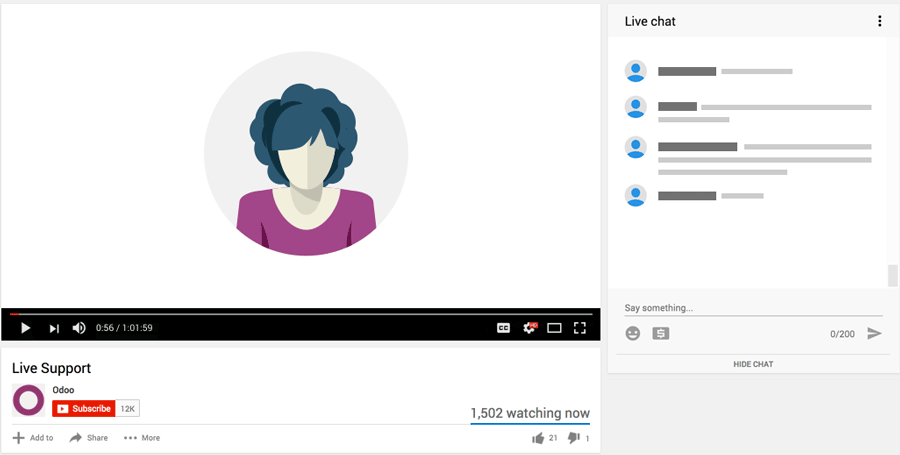
Odoo Experience on YouTube

1. Use the live chat to ask your questions.
2. The operator answers within a few minutes.

Live support on Youtube
Watch now