跳至內容
Odoo 選單
  • 登入
  • 免費試用
  • 應用程式
    財政
    • 會計
    • 發票
    • 開支報銷
    • 試算表 (BI)
    • 文件管理
    • 電子簽名
    銷售
    • 客戶關係
    • 銷售
    • POS 銷售點管理 - 零售
    • POS 銷售點管理 - 餐廳
    • 訂閱
    • 租賃
    網站
    • 網站製作
    • 電子商務
    • 網誌
    • 討論區
    • 線上客服
    • 網上學習
    供應鏈
    • 庫存
    • 製造管理
    • 產品生命周期
    • 採購
    • 保養維護
    • 品質管理
    人力資源
    • 員工管理
    • 招聘
    • 休假
    • 工作表現評核
    • 內部推薦
    • 車隊管理
    市場推廣
    • 社交媒體推廣
    • 電郵推廣
    • 短訊營銷
    • 活動
    • 自動化推廣
    • 網上調查
    服務
    • 專案管理
    • 工時管理
    • 外勤服務管理
    • 技術支援
    • 工作規劃
    • 預約管理
    生產力
    • 聊天
    • 批核
    • 物聯網
    • VoIP
    • 知識庫
    • WhatsApp
    第三方應用程式 Odoo Studio Odoo 雲端平台
  • 行業
    零售
    • 書店
    • 服裝店
    • 家具店
    • 食品雜貨店
    • 五金店
    • 玩具店
    餐飲及款待
    • 酒吧及酒館
    • 餐廳
    • 快餐
    • 賓館
    • 飲品分銷商
    • 酒店
    房地產
    • 地產代理公司
    • 建築師事務所
    • 建造業
    • 物業管理
    • 園藝
    • 業主聯會
    顧問服務
    • 會計公司
    • Odoo 合作夥伴
    • 市場推廣公司
    • 律師事務所
    • 人才招募
    • 審計及認證
    製造管理
    • 紡織
    • 金屬
    • 家具
    • 食品
    • 啤酒廠
    • 企業禮品
    保健與健身
    • 運動俱樂部
    • 眼鏡店
    • 健身中心
    • 健康從業人員
    • 藥房
    • 髮型屋
    技術行業
    • 雜工
    • IT 硬體與支援
    • 太陽能系統
    • 鞋匠
    • 清潔服務
    • 暖通空調服務
    其他
    • 非牟利組織
    • 環境保護機構
    • 廣告板租賃
    • 攝影服務
    • 自行車租賃
    • 軟體經銷商
    瀏覽所有行業
  • 社群
    學習
    • 教學影片
    • 使用說明
    • 認證
    • 培訓
    • 網誌
    • Podcast
    增強教學效能
    • 教育計劃
    • Scale Up! 商業遊戲
    • 到訪 Odoo
    取得軟件
    • 下載
    • 版本對照表
    • 版本說明
    合作
    • GitHub
    • 討論區
    • 活動
    • 翻譯
    • 成為合作夥伴
    • 合作夥伴服務
    • 登記你的會計服務公司
    獲取服務相關資料
    • 尋找合作夥伴
    • 尋找會計服務
    • 預約顧問諮詢
    • 安裝及推行服務
    • 客戶案例
    • 支援
    • 軟件升級
    GitHub YouTube Twitter LinkedIn Instagram Facebook Spotify
    +1 (650) 691-3277
    預約示範
  • 定價
  • 技術支援

Odoo is the world's easiest all-in-one management software.
It includes hundreds of business apps:

  • 客戶關係
  • e-Commerce
  • 會計
  • 庫存
  • PoS
  • 專案管理
  • MRP
All apps
只限註冊用戶才可與社群互動。
所有帖文 人 獎章
標籤 (查看所有)
odoo accounting v14 pos v15
關於此討論區
只限註冊用戶才可與社群互動。
所有帖文 人 獎章
標籤 (查看所有)
odoo accounting v14 pos v15
關於此討論區
支援

[ Suggestions required ] Instance wise Addons path + Database wise Addons path are feasible in Odoo ?

訂閱

此帖文有活動時,接收通知

此問題已被標幟
addonsaddonconfigodooV8
9 回覆
8239 瀏覽次數
頭像
Emipro Technologies Pvt. Ltd.

Hello All,

I am just seeking other Odoo expert's suggestions on whether following case may be possible/feasible or not in Odoo V8.  

We all very well know that, through Odoo conf file we can set Addons path. But sometimes, we don't want to show some modules in some specific databases. For example, in order to make invisible that module, if we delete module from module list, then also someone can easily make them available them via "Update Module List" menu. And sometimes, when we host Odoo for multiple customers in one server, then we don't want to show modules of customers to each other's.

Possible Way 1 :

So what I was thinking, that if somewhere in configuration parameter ( Settings >> Technical >> Parameters >> System Parameters menu), we can set addons path. Then at the time of database initialize from login screen, those specific modules also should be initialize.

So Odoo basic module's path will be taken from standard config file and customer specific modules will be taken from each database's configuration parameter. For example 3 paths specified in conf file and 1 path specified at configuration parameter under particular database then when you select the database at login time, from 4 paths, (3 from config, 1 for particular database) modules will be initialized.

Let me write some other alternative ways in case if above idea will not work. Other possible ways can be as follows,

Note : Generally end customers doesn't like to do any settings from py files so following ways would not be more suitable for end users. They like the policy "As more as from front end & as less as from back end". 

Possible Way 2 :

We can add one more attribute in "__openerp__.py" file like

in_databases : ['test1','test2']
So while doing "update module list" we will skip this module's visibility if current database is not in list of that parameter. Off course, in this custom module, there must be "auto_install" set to "True", otherwise someone can uninstall this module and our extended "update module list" method will not worked. ;) ;) ;)

Possible Way 3 :

We can add one more parameter in conf file which shall be kind of a dict ( "{}" ) in conf file.

addons_db_path = {'test1' : '/opt/odoo/test1_addons', 'test2' : '/opt/odoo/test2_addons'} 
so along with addons_path this new attribute will specify addons path for specific databse when some one click on "update module list"

Benefits of this kind of feature would be,

  • Database wise specific modules.

  • One database's specific modules will not be visible to any other database.

  • You can keep the same name but different features inside the modules.

  • You can easily manage different customer's modules into one single instance of Odoo.

  • Client specific modules will be total secured.

I am very keen and hopeful to get opinions of Odoo experts from this forum.


10
頭像
捨棄
頭像
Axel Mendoza
最佳答案

Hi @Empiro, this is very interesting topic, +1 for your question, I'd like to give you some ideas that I've managed since v7. 

In several terms it's not feasible right now to have a single Odoo instance for sharing modules to multiple database and it's due to your question topic, every database doesn't have/manage their own modules like in differents locations, meaning that you cannot have for the single instance database 1 using module A from /opt/odoo/repos/dev/A and database 2 using the same module A from /opt/odoo/repos/master/A since it will forget about one of those since the addons_path need to be composed of those two paths. Also like in your case databases 1 & 2 will have the modules specific of one visible to the other. And a module update could break one of the database without you know affecting the clients and normal use

Since Odoo need the modules loaded to do several computations and caches, the startup engine configure the threads/workers/process to use the modules loaded from the config addons_path. 

In my opinion the addons_path config need to be a triple like (worker, database, addons_path), something like if one worker get spawn it need to be database specific and needs to load the addons_path module code for that database, then you need to manage workers like a pool and also have a way to correctly use an specific addons_path code for assume requests to that database.

What I'm talking about is to have a worker/process/thread memory for addons_path isolation. In this case the database will have their own modules since the workers that managed it will be contains the specific addons_path and using Update module list will cause no harm. Using this approach the workers will be memory variables since they don't need to load all the modules for all the databases universe, they just need to load the specific database configuration. I think that a worker master for every database need to exist in order to spawn/destroy child workers for every database just with a fork but without been a fork of the main Odoo process, just using interprocess comunication with Odoo master process

- Odoo master process
    - Worker master for database 1
        - Worker child process for database 1
        - Worker child process for database 1
        - Worker child process for database 1
    - Worker master for database 2 
        - Worker child process for database 2
        - Worker child process for database 2
        - Worker child process for database 2

Because features like this are None, we are using the approach of create one instance of Odoo per database(normally a customer or using the same instance for others tests database of the development/production main one) but without having a big instance of modules for database 1 and 2. Using Nginx for dispatch to the needed instance. That way the database instance will manage only the modules of their specific addons cloned and managed specifically for the instance using fabric in combination with an Odoo UI deploy module tool

3
頭像
捨棄
Emipro Technologies Pvt. Ltd.
作者

Thanks @Axel, I will read and back to you with my thoughts. But +1 for your wonderful effort and time.

Axel Mendoza

To crazy my ideas?

頭像
Yenthe Van Ginneken (Mainframe Monkey)
最佳答案

Hi Emipro,

I was wondering why you would want to make these things so complex. Imagine building your in_databases like this:

in_databases : ['test1','test2']

Imagine that you have 20 customers on your server. This would mean that you would have to modify this code every time in your module. That sounds like a pain and sooner or later you will make errors in this. If I understand you correctly you basically don't want to show custom modules to all your customers/users. Wouldn't it be an option to create a new option in your __openerp__.py like this:

admin_only_module: 'True'

If the option is true the module will be visible in all databases but only for the superadmin user (id 1).
If the option is set to 'False' it will be visible to any database and any user.

Wouldn't this solve your problems?

Update: Now that you've added an extra response on my answer and your extra samples I would honestly say that your option two sounds the best. This sounds like a more flexible way then option 1. I would personally use option #2 if it was up to me.


Yenthe


3
頭像
捨棄
Emipro Technologies Pvt. Ltd.
作者

@yenthe this "admin_only_module" would not be good option, because of when you give demo database to your client obviously they will/should/must able to login via admin and they can easily view all the modules of other clients. I have write two alternative ways when the explanation of my main paragraph is not feasible. So by database wise addons path is not good way ? Please think on this. However we should also design system in so simple way that end customer, who don't know __openerp__.py file can easily configure their addons path. "More from frontend and less from backend". Appreciating your prompt response and that will lead to +1 upvote from me.

Emipro Technologies Pvt. Ltd.
作者

@Yenthe By the way, there is very rare cases in which anyone needs to manage 20+ clients from single instance of Odoo.

Yenthe Van Ginneken (Mainframe Monkey)

@Emipro why would you give the admin account to any user at any time? You can create a new user with, I assume, all the rights and accesses that you'd ever need. Our customers never get access to the main admin account for a specific Odoo. Judging by your answers I would honestly say to go with option #2. Thats a pretty clean solution.

Emipro Technologies Pvt. Ltd.
作者

@Yenthe its quite normal, we manage separate database for each customers then they might need admin account. In normal case or specially to our clients we are giving total database access to our clients. They can do anything inside their account. One of the simple example I would like to give you is suppose you host your database at Odoo itself. Now you won't need admin access to manage your database separately ???????????? Now in case if Odoo don't want to show Xyz customer's module to you then what is the available option ? That's what I am trying to figure out. ( This is just example, please don't say that Odoo don't allow to host any other community modules :D)

Axel Mendoza

In this case I go with option 1 or an external cache like Redis

頭像
Solanki Shamji
最佳答案

Hello,

My suggestion is that

If you provide SAAS to the customer than dont give access of setting menu or module installation.

Give separate user for separate client and manage using access right.

Thanks.

Shamji


0
頭像
捨棄
喜歡這則討論?不要只閱讀,加入發表意見吧!

今天就建立帳戶,享受獨家功能,與我們精彩的社群互動!

註冊
相關帖文 回覆 瀏覽次數 活動
Error addons install in Odoo 13 versión comnunity
addons addon
頭像
頭像
2
4月 20
3946
addon install - what's the correct way to do it?
dms addons addon
頭像
0
7月 21
4216
Odoo 11 - HOw can I get the Odoo Enterprise Addons
addons addon odoov11
頭像
頭像
2
12月 19
5903
"Update modules list" not finding newly added modules. What else can I try? 已解決
modules addons config
頭像
頭像
頭像
頭像
頭像
6
12月 23
26661
How do I import an addon module (from a python shell)? 已解決
python addons addon
頭像
1
3月 15
12189
社群
  • 教學影片
  • 使用說明
  • 討論區
開源
  • 下載
  • GitHub
  • Runbot 測試環境
  • 翻譯
服務
  • odoo.sh 網頁寄存
  • 支援
  • 升級
  • 自訂功能開發
  • 教育及培訓
  • 尋找會計服務
  • 尋找合作夥伴
  • 成為合作夥伴
關於我們
  • 關於 Odoo 公司
  • 品牌資產
  • 聯絡我們
  • 招聘
  • 活動
  • Podcast
  • 網誌
  • 客戶
  • 法律 • 私隱政策
  • 安全性
الْعَرَبيّة Català 简体中文 繁體中文 (台灣) Čeština Dansk Nederlands English Suomi Français Deutsch हिंदी Bahasa Indonesia Italiano 日本語 한국어 (KR) Lietuvių kalba Język polski Português (BR) română русский язык Slovenský jazyk slovenščina Español (América Latina) Español ภาษาไทย Türkçe українська Tiếng Việt

Odoo 是一套開放源碼的商業管理系統,涵蓋你公司全部的營運需要,包括客戶關係管理(CRM)、電子商務、會計、庫存管理、POS(銷售點管理)、專案管理等應用程式。

Odoo 的獨特價值是非常簡單易用,同時將不同應用程式完美整合。

Website made with

Odoo Experience on YouTube

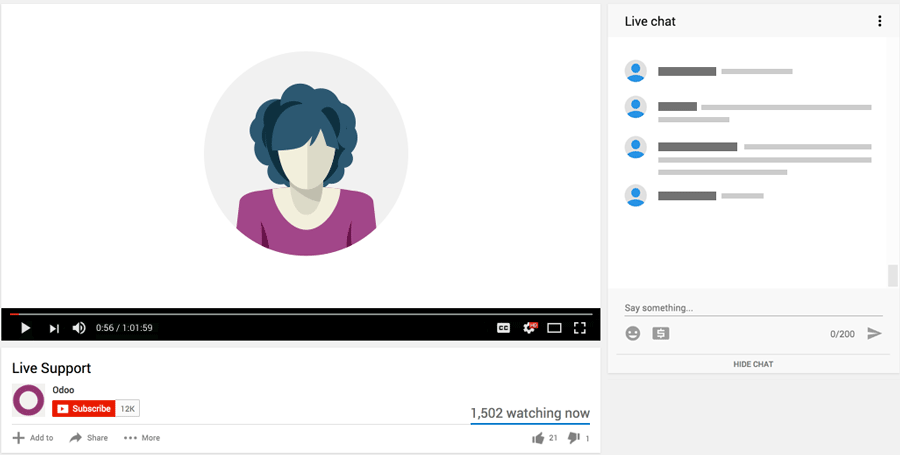
1. Use the live chat to ask your questions.
2. The operator answers within a few minutes.

Live support on Youtube
Watch now