Pular para o conteúdo
Odoo Menu
  • Entrar
  • Experimente grátis
  • Aplicativos
    Finanças
    • Financeiro
    • Faturamento
    • Despesas
    • Planilhas (BI)
    • Documentos
    • Assinar Documentos
    Vendas
    • CRM
    • Vendas
    • PDV Loja
    • PDV Restaurantes
    • Assinaturas
    • Locação
    Websites
    • Criador de Sites
    • e-Commerce
    • Blog
    • Fórum
    • Chat ao Vivo
    • e-Learning
    Cadeia de mantimentos
    • Inventário
    • Fabricação
    • PLM - Ciclo de Vida do Produto
    • Compras
    • Manutenção
    • Qualidade
    Recursos Humanos
    • Funcionários
    • Recrutamento
    • Folgas
    • Avaliações
    • Indicações
    • Frota
    Marketing
    • Redes Sociais
    • Marketing por E-mail
    • Marketing por SMS
    • Eventos
    • Automação de Marketing
    • Pesquisas
    Serviços
    • Projeto
    • Planilhas de Horas
    • Serviço de Campo
    • Central de Ajuda
    • Planejamento
    • Compromissos
    Produtividade
    • Mensagens
    • Aprovações
    • Internet das Coisas
    • VoIP
    • Conhecimento
    • WhatsApp
    Aplicativos de terceiros Odoo Studio Plataforma Odoo Cloud
  • Setores
    Varejo
    • Loja de livros
    • Loja de roupas
    • Loja de móveis
    • Mercearia
    • Loja de ferramentas
    • Loja de brinquedos
    Comida e hospitalidade
    • Bar e Pub
    • Restaurante
    • Fast Food
    • Hospedagem
    • Distribuidor de bebidas
    • Hotel
    Imóveis
    • Imobiliária
    • Escritório de arquitetura
    • Construção
    • Administração de propriedades
    • Jardinagem
    • Associação de proprietários de imóveis
    Consultoria
    • Escritório de Contabilidade
    • Parceiro Odoo
    • Agência de marketing
    • Escritório de advocacia
    • Aquisição de talentos
    • Auditoria e Certificação
    Fabricação
    • Têxtil
    • Metal
    • Móveis
    • Alimentação
    • Cervejaria
    • Presentes corporativos
    Saúde e Boa forma
    • Clube esportivo
    • Loja de óculos
    • Academia
    • Profissionais de bem-estar
    • Farmácia
    • Salão de cabeleireiro
    Comércio
    • Handyman
    • Hardware e Suporte de TI
    • Sistemas de energia solar
    • Sapataria
    • Serviços de limpeza
    • Serviços de climatização
    Outros
    • Organização sem fins lucrativos
    • Agência Ambiental
    • Aluguel de outdoors
    • Fotografia
    • Aluguel de bicicletas
    • Revendedor de software
    Navegar por todos os setores
  • Comunidade
    Aprenda
    • Tutoriais
    • Documentação
    • Certificações
    • Treinamento
    • Blog
    • Podcast
    Empodere a Educação
    • Programa de educação
    • Scale Up! Jogo de Negócios
    • Visite a Odoo
    Obtenha o Software
    • Baixar
    • Comparar edições
    • Releases
    Colaborar
    • Github
    • Fórum
    • Eventos
    • Traduções
    • Torne-se um parceiro
    • Serviços para parceiros
    • Cadastre seu escritório contábil
    Obtenha os serviços
    • Encontre um parceiro
    • Encontre um Contador
    • Conheça um consultor
    • Serviços de Implementação
    • Referências de Clientes
    • Suporte
    • Upgrades
    Github YouTube Twitter Linkedin Instagram Facebook Spotify
    +1 (650) 691-3277
    Faça uma demonstração
  • Preços
  • Ajuda

Odoo is the world's easiest all-in-one management software.
It includes hundreds of business apps:

  • CRM
  • e-Commerce
  • Financeiro
  • Inventário
  • PoS
  • Projeto
  • MRP
All apps
É necessário estar registrado para interagir com a comunidade.
Todas as publicações Pessoas Emblemas
Marcadores (Ver tudo)
odoo accounting v14 pos v15
Sobre este fórum
É necessário estar registrado para interagir com a comunidade.
Todas as publicações Pessoas Emblemas
Marcadores (Ver tudo)
odoo accounting v14 pos v15
Sobre este fórum
Ajuda

How to pass a value from a class to an other class?

Inscrever

Seja notificado quando houver atividade nesta publicação

Esta pergunta foi sinalizada
2 Respostas
5954 Visualizações
Avatar
Pascal Tremblay

Hello all of you,

I would need to understand a new concept...

See example first class :

class report_saleslines_pt(models.AbstractModel):

    _name = 'report.point_of_sale.report_saleslines'
    _template = 'point_of_sale.report_saleslines'

    @api.multi
    def render_html(self, data=None):
       report.choosen_paper = a_number_or_object
 

We have a second class.

class Report(osv.Model):
    _inherit = "report"
    _name = "report"
    _description = "Report"

    @api.v7
    def get_pdf(self, cr, uid, ids, report_name, html=None, data=None, context=None):
        paper = report.choosen_paper


Our two classes work well and are well declared (I didn't paste all the code).

How could I give a value to report.choosen_paper in the class report_saleslines_pt and after recup this value in get_pdf() from the class report?

How to exchange temp value beetqween classes?

Do you understand what I mean?

Thanks for words or idea.


FIRST UPDATE ::::

See example first class :

class report_saleslines_pt(models.AbstractModel):

    _name = 'report.point_of_sale.report_saleslines'
    _template = 'point_of_sale.report_saleslines'

    @api.multi
    def render_html(self, data=None):
        self.env['report'].with_context(exchangeVAR='KILLINGDESTROY')


We have a second class.

class Report(osv.Model):
    _inherit = "report"
    _name = "report"
    _description = "Report"

    @api.v7
    def get_pdf(self, cr, uid, ids, report_name, html=None, data=None, context=None):  

         _logger.error("REPORT_LAPAGEPT :: %s %s", 'CONTEXT :: ', context)

I can now see the context in my log. But still NO trace of exchangeVAR in the context.

Thanks

0
Avatar
Cancelar
Pascal Tremblay
Autor

I don't want to change any value in the database. I just want a kind of global value.

Zbik

pass with context?

Pascal Tremblay
Autor

I have printed this : https://www.odoo.com/fr_FR/forum/help-1/question/whats-the-context-2236 Trying it. Thanks

Pascal Tremblay
Autor

Not able to modify context in render_html. ANd make this context the same than in get_pdf

Avatar
Zbik
Melhor resposta

@Pascal, see how works get_pdf(). In first step (on begining) call self.get_html(). In get_html() I see ... return particularreport_obj.render_html() ... render_html() you inherit... context propagates in the opposite direction

1
Avatar
Cancelar
Pascal Tremblay
Autor

Thanks A LOT!!!!! Again! I have learned many important concepts. I will publish my code soon.

Avatar
Pascal Tremblay
Autor Melhor resposta

FIRST CLASS

from openerp import api
from openerp import SUPERUSER_ID
from openerp.exceptions import AccessError
from openerp.osv import osv
from openerp.tools import config
from openerp.tools.misc import find_in_path
from openerp.tools.translate import _
from openerp.addons.web.http import request
from openerp.tools.safe_eval import safe_eval as eval

import re
import time
import base64
import logging
import tempfile
import lxml.html
import os
import subprocess
from contextlib import closing
from distutils.version import LooseVersion
from functools import partial
from pyPdf import PdfFileWriter, PdfFileReader


import logging
_logger = logging.getLogger(__name__)


class Report(osv.Model):
    _inherit = "report"
    _name = "report"
    _description = "Report"

    def whichCompanyPrefix(self):
        self.cr, self.uid, self.pool = request.cr, request.uid, request.registry
        user = self.pool["res.users"].browse(self.cr, self.uid, self.uid)
    
        company_id = user.company_id.id
        #_logger.error('ID = ' + str(company_id))
        company_name = user.company_id.name
        #_logger.error('NAME = ' + company_name)
        company_prefix = user.company_id.x_company_prefix
        
        if not company_prefix :
 
            company_prefix = 'ZZ'
        
        _logger.error('REPORT_LAPAGEPT :: PREFIX = ' + company_prefix)
        
        return company_prefix


    def choosePaper(self, report, user):
        _logger.error('REPORT_LAPAGEPT :: CHOOSEPAPER : ')

        modelll = report.model
        #Tous les rapports dans le point de vente.
        if modelll == 'pos.order':
            cie_pos_paperformat = user.company_id.x_pos_paperformat
            
            if cie_pos_paperformat:
                paperformat = cie_pos_paperformat
                _logger.error('REPORT_LAPAGEPT :: PAPIER POS DE LA COMPAGNIE : ' + str(paperformat))
            elif report.paperformat_id:
                paperformat = report.paperformat_id
                _logger.error('REPORT_LAPAGEPT :: PAPIER DU REPORT : ' + str(paperformat))
            else:
                ref = partial(self.pool['ir.model.data'].xmlid_to_res_id, cr, SUPERUSER_ID)
                ref_id = ref('report.paperformat_us')
                paperformat = self.pool['report.paperformat'].browse(cr, SUPERUSER_ID, ref_id, context=context)
                
                _logger.error('REPORT_LAPAGEPT :: PAPIER PAR DEFAUT LETTER : ' + str(paperformat))
        
        #Tous les rapports hors du menu point de vente.
        else:
            cie_paperformat = user.company_id.paperformat_id
            
            if cie_paperformat:
                paperformat = user.company_id.paperformat_id
            else:
                paperformat = report.paperformat_id
    

        return paperformat
    
    @api.v7
    def get_html(self, cr, uid, ids, report_name, data=None, context=None):
        """This method generates and returns html version of a report.
        """
        # If the report is using a custom model to render its html, we must use it.
        # Otherwise, fallback on the generic html rendering.
        _logger.error('REPORT_LAPAGEPT :: GET_HTML ' + str(report_name))
        
        report = self._get_report_from_name(cr, uid, report_name)

        user = self.pool['res.users'].browse(cr, uid, uid)
        
        chosenPaper = Report.choosePaper(self, report, user)
        
        _logger.error('REPORT_LAPAGEPT :: GET_PDF : CHOSENPAPER ' + str(chosenPaper))
        
        context.update({'chosenPaper':chosenPaper})
        
        try:
            report_model_name = 'report.%s' % report_name
            particularreport_obj = self.pool[report_model_name]
            return particularreport_obj.render_html(cr, uid, ids, data=data, context=context)
        except KeyError:
            report = self._get_report_from_name(cr, uid, report_name)
            report_obj = self.pool[report.model]
            docs = report_obj.browse(cr, uid, ids, context=context)
            docargs = {
                'doc_ids': ids,
                'doc_model': report.model,
                'docs': docs,
            }
            return self.render(cr, uid, [], report.report_name, docargs, context=context)

    @api.v7
    def get_pdf(self, cr, uid, ids, report_name, html=None, data=None, context=None):
        """This method generates and returns pdf version of a report.
        """
        _logger.error('REPORT_LAPAGEPT :: GET_PDF BEGIN' + str(report_name))

        if context is None:
            context = {}

        if html is None:
            html = self.get_html(cr, uid, ids, report_name, data=data, context=context)

        html = html.decode('utf-8')  # Ensure the current document is utf-8 encoded.

        # Get the ir.actions.report.xml record we are working on.
        report = self._get_report_from_name(cr, uid, report_name)

        # Check if we have to save the report or if we have to get one from the db.
        save_in_attachment = self._check_attachment_use(cr, uid, ids, report)

        paperformat = context.get('chosenPaper')

        # Preparing the minimal html pages
        css = ''  # Will contain local css
        headerhtml = []
        contenthtml = []
        footerhtml = []
        irconfig_obj = self.pool['ir.config_parameter']
        base_url = irconfig_obj.get_param(cr, SUPERUSER_ID, 'report.url') or irconfig_obj.get_param(cr, SUPERUSER_ID, 'web.base.url')

        # Minimal page renderer
        view_obj = self.pool['ir.ui.view']
        render_minimal = partial(view_obj.render, cr, uid, 'report.minimal_layout', context=context)

        # The received html report must be simplified. We convert it in a xml tree
        # in order to extract headers, bodies and footers.
        try:
            root = lxml.html.fromstring(html)
            match_klass = "//div[contains(concat(' ', normalize-space(@class), ' '), ' {} ')]"

            for node in root.xpath("//html/head/style"):
                css += node.text

            for node in root.xpath(match_klass.format('header')):
                body = lxml.html.tostring(node)
                header = render_minimal(dict(css=css, subst=True, body=body, base_url=base_url))
                headerhtml.append(header)

            for node in root.xpath(match_klass.format('footer')):
                body = lxml.html.tostring(node)
                footer = render_minimal(dict(css=css, subst=True, body=body, base_url=base_url))
                footerhtml.append(footer)

            for node in root.xpath(match_klass.format('page')):
                # Previously, we marked some reports to be saved in attachment via their ids, so we
                # must set a relation between report ids and report's content. We use the QWeb
                # branding in order to do so: searching after a node having a data-oe-model
                # attribute with the value of the current report model and read its oe-id attribute
                if ids and len(ids) == 1:
                    reportid = ids[0]
                else:
                    oemodelnode = node.find(".//*[@data-oe-model='%s']" % report.model)
                    if oemodelnode is not None:
                        reportid = oemodelnode.get('data-oe-id')
                        if reportid:
                            reportid = int(reportid)
                    else:
                        reportid = False

                # Extract the body
                body = lxml.html.tostring(node)
                reportcontent = render_minimal(dict(css=css, subst=False, body=body, base_url=base_url))

                contenthtml.append(tuple([reportid, reportcontent]))

        except lxml.etree.XMLSyntaxError:
            contenthtml = []
            contenthtml.append(html)
            save_in_attachment = {}  # Don't save this potentially malformed document

        # Get paperformat arguments set in the root html tag. They are prioritized over
        # paperformat-record arguments.
        specific_paperformat_args = {}
        for attribute in root.items():
            if attribute[0].startswith('data-report-'):
                specific_paperformat_args[attribute[0]] = attribute[1]


        _logger.error('REPORT_LAPAGEPT :: GET_PDF END' + str(report_name))

        # Run wkhtmltopdf process
        return self._run_wkhtmltopdf(
            cr, uid, headerhtml, footerhtml, contenthtml, context.get('landscape'),
            paperformat, specific_paperformat_args, save_in_attachment
        )


SECOND CLASS

import logging
_logger = logging.getLogger(__name__)
from openerp import api, models

class report_saleslines_pt(models.AbstractModel):
    _name = 'report.point_of_sale.report_saleslines'
    _template = 'point_of_sale.report_saleslines'

    @api.multi
    def render_html(self, data=None):

        report_obj = self.env['report']
        report = report_obj._get_report_from_name('point_of_sale.report_saleslines')
        context2 = self.env.context
        
        _logger.error("REPORT_SALELINES_PT :: RENDER_HTML :: %s %s", 'CONTEXT :: ', context2)
        
        paperformat_obj = context2.get('chosenPaper')
        
        _logger.error("REPORT_SALELINES_PT :: RENDER_HTML :: %s %s", 'CHOSENPAPER :: ', paperformat_obj)
        
        docargs = {
            'paperformat': paperformat_obj,
            'doc_ids': self._ids,
            'doc_model': report.model,
            'docs': self,
        }
        return report_obj.render('point_of_sale.report_saleslines', docargs)

report_saleslines_pt()


0
Avatar
Cancelar
Está gostando da discussão? Não fique apenas lendo, participe!

Crie uma conta hoje mesmo para aproveitar os recursos exclusivos e interagir com nossa incrível comunidade!

Inscreva-se
Comunidade
  • Tutoriais
  • Documentação
  • Fórum
Open Source
  • Baixar
  • Github
  • Runbot
  • Traduções
Serviços
  • Odoo.sh Hosting
  • Suporte
  • Upgrade
  • Desenvolvimentos personalizados
  • Educação
  • Encontre um Contador
  • Encontre um parceiro
  • Torne-se um parceiro
Sobre nós
  • Nossa empresa
  • Ativos da marca
  • Contato
  • Empregos
  • Eventos
  • Podcast
  • Blog
  • Clientes
  • Legal • Privacidade
  • Segurança
الْعَرَبيّة Català 简体中文 繁體中文 (台灣) Čeština Dansk Nederlands English Suomi Français Deutsch हिंदी Bahasa Indonesia Italiano 日本語 한국어 (KR) Lietuvių kalba Język polski Português (BR) română русский язык Slovenský jazyk slovenščina Español (América Latina) Español ภาษาไทย Türkçe українська Tiếng Việt

Odoo é um conjunto de aplicativos de negócios em código aberto que cobre todas as necessidades de sua empresa: CRM, comércio eletrônico, contabilidade, estoque, ponto de venda, gerenciamento de projetos, etc.

A proposta de valor exclusiva Odoo é ser, ao mesmo tempo, muito fácil de usar e totalmente integrado.

Site feito com

Odoo Experience on YouTube

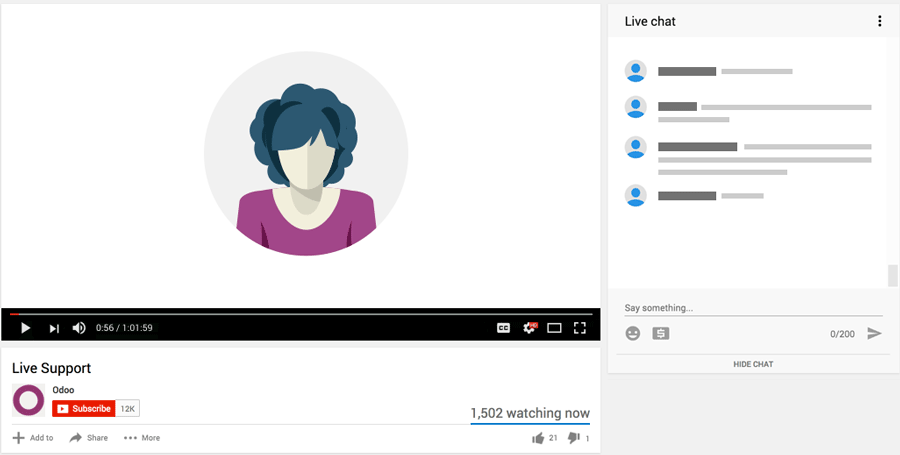
1. Use the live chat to ask your questions.
2. The operator answers within a few minutes.

Live support on Youtube
Watch now