Ir al contenido
Odoo Menú
  • Inicia sesión
  • Pruébalo gratis
  • Aplicaciones
    Finanzas
    • Contabilidad
    • Facturación
    • Gastos
    • Firma electrónica
    • Hoja de cálculo
    • ESG
    Ventas
    • CRM
    • Ventas
    • Suscripciones
    • PdV para tiendas
    • PdV para restaurantes
    • Alquiler
    Sitios web
    • Creador de sitios web
    • Comercio electrónico
    • Eventos
    • Blog
    • eLearning
    • Foro
    Cadena de suministro
    • Inventario
    • Manufactura
    • Mantenimiento
    • PLM
    • Calidad
    • Compras
    Recursos humanos
    • Empleados
    • Nómina
    • Reclutamiento
    • Vacaciones
    • Evaluaciones
    • Flotilla
    Marketing
    • Redes sociales
    • Marketing por correo
    • Marketing por SMS
    • Automatización de marketing
    • WhatsApp
    • Encuestas
    Servicios
    • Proyectos
    • Registro de horas
    • Planeación
    • Citas
    • Chat en vivo
    • Soporte al cliente
    Productividad
    • Inteligencia artificial
    • Conversaciones
    • Phone
    • IoT
    • Documentos
    • Artículos
    Aplicaciones externas Studio de Odoo Plataforma de Odoo en la nube
  • Industrias
    Venta minorista
    • Librería
    • Tienda de ropa
    • Mueblería
    • Tienda de abarrotes
    • Ferretería
    • Juguetería
    Alimentos y hospitalidad
    • Bar y cafetería
    • Restaurante
    • Comida rápida
    • Casa de huéspedes
    • Distribuidora de bebidas
    • Hotel
    Bienes inmuebles
    • Agencia inmobiliaria
    • Estudio de arquitectura
    • Construcción
    • Gestión de propiedades
    • Jardinería
    • Asociación de propietarios
    Consultoría
    • Firma contable
    • Partner de Odoo
    • Agencia de marketing
    • Bufete de abogados
    • Adquisición de talentos
    • Auditorías y certificaciones
    Manufactura
    • Textil
    • Metal
    • Muebles
    • Comida
    • Cervecería
    • Regalos corporativos
    Salud y ejercicio
    • Sports Facilities
    • Óptica
    • Gimnasio
    • Personal Trainer
    • Farmacia
    • Peluquería
    Servicios
    • Personal de mantenimiento
    • Hardware y soporte informático
    • Sistemas de energía solar
    • Tienda de electrónicos
    • Servicios de limpieza
    • Servicios de calefacción, ventilación y aire acondicionado
    Otros
    • Organización sin fines de lucro
    • Agencia para la protección del medio ambiente
    • Alquiler de anuncios publicitarios
    • Fotografía
    • Alquiler de bicicletas
    • Distribuidor de software
    Consulta todas las industrias ⟶
  • Comunidad
    Aprende
    • Tutoriales
    • Documentación
    • Certificaciones
    • Capacitación
    • Blog
    • Podcast
    Fortalece la educación
    • Programa educativo
    • Scale Up! El juego empresarial
    • Visita Odoo
    Obtén el software
    • Descargar
    • Compara ediciones
    • Versiones
    Colabora
    • GitHub
    • Foro
    • Eventos
    • Traducciones
    • Conviértete en partner
    • Servicios para partners
    • Registra tu firma contable
    • Programa de afiliados
    Obtén servicios
    • Encuentra un partner
    • Encuentra un contador
    • Contacta a un consultor
    • Servicios de implementación
    • Referencias de clientes
    • Soporte
    • Actualizaciones
    GitHub YouTube X LinkedIn Instagram Facebook Spotify
    +1 (650) 691-3277
    Solicita una demostración
  • Precios
  • Ayuda

Trust Center

Security, Privacy and Compliance

Compliance

Certifications & Audits

ISO 27001 ISO/IEC 27001:2022 certified SOC 2 Type II Security, Availability and Confidentiality SOC 1 Type II Controls relevant to financial reporting CSA STAR Cloud Controls Matrix and CAIQ GoBD German bookkeeping principles · IDW PS 880

Regulatory Compliance

GDPR EU General Data Protection Regulation NIS 2 Network and Information Security Directive DORA Digital Operational Resilience Act EU AI Act Risk-based rules for AI systems CRA Cyber Resilience Act

Security Information

Terms of Service

  • Privacy Policy
  • Security Policy
  • Enterprise Subscription Agreement
  • Partnership Agreement
  • General Terms of Sale
  • Acceptable Use Policy
  • In-App Purchase Privacy Policy

Infrastructure

  • Architecture & Data Isolation
  • Data Center & Physical Security
  • Business Continuity & Disaster Recovery

Security Features

  • Audit Logging & Traceability
  • Data Security
  • Integrations
  • Password & Multi-Factor Authentication
  • Identity & Access Management
  • Single Sign-On (SSO)
  • User Management

Privacy & Data Protection

  • Cookies
  • Information we collect
  • Data Processing Agreement
  • Data Protection Team
  • Security Incident Notifications

Application Security

  • Responsible Disclosure
  • Secure Development & Automated Security Testing
  • Application Security by Design

Documents

ISO 27001 Certificate

Certification

ISO/IEC 27001:2022 certificate for Odoo's Information Security Management System.

Request access

SOC 1 and 2 Type II reports

Audit

Independent SOC 1 and SOC 2 Type II attestation reports.

Request access

GoBD Audit Report

Audit

IDW PS 880 audit report on GoBD compliance

Request access

Frequently Asked Questions

Odoo uses multiple layers of technical and organizational security controls to protect customer data. These include encryption in transit and at rest, database isolation, role-based access controls, hardened infrastructure, continuous monitoring, backups, vulnerability management, and incident response procedures. Odoo Cloud security controls are also independently assessed through annual SOC 2 Type II audits.

Customer data on Odoo Cloud is encrypted both in transit and at rest. Connections to customer instances are protected using HTTPS, and customer database content and stored files are encrypted at rest, including backups.

Each Odoo SaaS customer's data resides in a separate database. Odoo.sh additionally isolates each customer's environment and custom code using operating-system-level containerization.

Odoo operates cloud infrastructure across multiple geographic regions. Depending on the service and selected region, infrastructure providers include Google Cloud, OVHcloud and AWS. Odoo's Privacy Policy identifies the relevant subprocessors and the data they process.

Access is restricted according to the principle of least privilege. Certain authorized personnel, such as Helpdesk staff when handling a support request, consultants working on a customer engagement, and core infrastructure personnel responsible for operating the platform, may access customer environments when necessary. Access uses personal credentials, is logged and auditable, and privileged access is subject to security controls.

Odoo maintains 14 full backups of each Odoo database over a three-month rotation. Backups and redundancy mechanisms are automated, monitored, geographically replicated, and continuously exercised.

For more information see also the Odoo Cloud SLA.

Odoo does not use any customer data for training, fine-tuning, or evaluating AI models. Odoo integrates third-party foundation models (such as OpenAI's GPT model and Google's Gemini models) and enforces strict privacy boundaries by default to ensure that inputs are processed solely for immediate inference.

AI features in Odoo products are optional. For more information see also the Odoo IAP Privacy Policy and the AI Features documentation.
ISO/IEC 27001:2022 Certification

Odoo is ISO/IEC 27001:2022 certified: its Information Security Management System (ISMS) has been independently assessed against the international standard.

Certification scope

The certified ISMS covers the design, development, delivery and support of Odoo software solutions, professional services, trusted platform services and Odoo cloud hosting, including Odoo Online (SaaS) and Odoo.sh (PaaS).

What the ISMS provides

A structured, risk-based approach to protecting information and continuously improving security practices. It covers security governance, risk management, access control, incident management, supplier security, business continuity and the protection of information throughout its lifecycle.

Independent assurance

An independent certification body assessed the ISMS against ISO/IEC 27001:2022 within the defined scope. The certification complements Odoo's wider assurance program: SOC reports, security monitoring, vulnerability management, secure development and incident response.

Request the ISO certificate
SOC 2 Type II

Odoo Cloud Hosting (SaaS) and Odoo.sh (PaaS) are covered by an independent SOC 2 Type II examination against the Trust Services Criteria for Security, Availability and Confidentiality.

What a Type II examination covers

Unlike a point-in-time assessment, it evaluates both the design of the controls and whether they operated effectively throughout the audit period. The auditor tests the controls supporting Odoo's security, availability and confidentiality commitments.

Control coverage

Security governance, access management, infrastructure protection, system monitoring, vulnerability management, incident response, change management, availability, business continuity and the protection of confidential information.

Who it is for

Customers, partners, auditors and other authorized stakeholders who need independent evidence of how Odoo's cloud security controls operate.

Report status

SOC reports relate to a defined system and review period. They are independent attestation reports, not certifications with a conventional expiry date.

Request the SOC reports
SOC 1 Type II

SOC 1 Type II reports give independent assurance over controls at a service organization that may be relevant to customers' internal control over financial reporting.

What a Type II examination covers

Whether the relevant controls are appropriately designed and whether they operated effectively throughout the stated review period.

Who it is for

Primarily finance, accounting, audit and risk teams assessing how outsourced services affect their financial reporting controls.

Reading the report

Consider its full scope: the auditor's opinion, reporting period, control objectives, test results, exceptions, sub-service organizations and the complementary controls that customers are responsible for operating.

Report status

SOC reports relate to a defined system and review period. They are independent attestation reports, not certifications with a conventional expiry date.

Request the SOC reports
Cloud Security Alliance (CSA) STAR

Odoo participates in the Cloud Security Alliance STAR program and publishes its Cloud Controls Matrix (CCM) and Consensus Assessments Initiative Questionnaire (CAIQ) security information.

GoBD Compliance

Odoo 19 has been audited for GoBD compliance in accordance with IDW PS 880. The GoBD are the German principles for the proper keeping and retention of books, records and documents in electronic form, and for data access.

About the audit

The audit was performed in accordance with IDW PS 880, the German auditing standard for software products. The audit report is available on request, under NDA.

Who it applies to

The GoBD are binding for companies that have to present accounts to the German financial authorities, including SMEs, freelancers and entrepreneurs.

How Odoo supports it

The GoBD require records to be traceable, verifiable, true, clear and continuous. With the German fiscal localization, Odoo provides:

  • an audit trail, enabled by default;
  • gap-free numbering of financial transactions;
  • timely recording out of the box, as most financial data is generated by transactional documents (for example, an invoice is posted when confirmed);
  • a default configuration that supports the inalterability of posted records; and
  • export of financial data in CSV and XLS formats.
Your responsibility

Odoo provides the tools needed to follow the software-related GoBD guidelines. Compliance also depends on how the software is configured and used, for example by recording incoming vendor bills and miscellaneous operations in a timely manner.

Read the GoBD documentation Request the GoBD audit report
General Data Protection Regulation (GDPR)

The GDPR sets requirements for the lawful, fair, transparent and secure processing of personal data. Odoo builds privacy and data protection into its services, contracts and security practices.

Odoo's role

It depends on the processing activity. For personal data Odoo processes for its own purposes (such as account, website, contractual or business-contact information), Odoo is a data controller.

For personal data stored in a customer's Odoo cloud database, the customer is generally the controller and Odoo is a processor. The applicable data-processing terms define each party's responsibilities.

Safeguards

Technical and organizational measures cover access control, encryption, infrastructure security, backup and resilience, security monitoring, incident response, vulnerability management and personnel access. Odoo also maintains processes for data-subject rights, personal-data breach management, third-party processing and international transfers where applicable.

Your responsibility

GDPR compliance is a shared responsibility. Customers determine the purposes and means of processing in their databases and remain responsible for lawful basis, privacy notices, user access, retention, data-subject requests, integrations and international transfers.

See Odoo's Privacy Policy and data-processing terms for authoritative information.

Read the Odoo GDPR statement
Network and Information Security Directive (NIS2)

NIS2 establishes cybersecurity risk-management and incident-reporting duties for covered essential and important entities in the EU.

Odoo's security framework

Odoo's ISO/IEC 27001:2022-certified ISMS is a structured foundation for managing cybersecurity risk and supporting NIS2 requirements. It covers risk management, incident detection and response, business continuity and disaster recovery, access control and authentication, vulnerability management, encryption, supply-chain security and security monitoring, complemented by secure development practices, vulnerability assessments and independent assurance.

Incident management and resilience

Odoo maintains processes to identify, assess, escalate and respond to security incidents, together with business continuity, backup, disaster recovery and infrastructure resilience measures.

Odoo's status

Odoo recognizes its responsibilities under the EU's NIS2 framework as an Essential Entity and maintains a security program designed to support the applicable risk-management and incident-reporting requirements.

Your responsibility

Whether NIS2 applies to you, and how, depends on your sector, size, jurisdiction and role. Odoo's controls, ISO 27001 certification, assurance reports and security documentation can support your supplier-security and ICT risk assessments, but each organization must determine and meet its own legal obligations, including national reporting requirements.

Digital Operational Resilience Act (DORA)

DORA sets EU requirements for the digital operational resilience of regulated financial entities: ICT risk management, resilience, incident reporting, testing and third-party risk.

How Odoo supports DORA customers

Odoo maintains security, availability, resilience and supplier-management controls that can contribute to a customer's ICT risk-management and third-party due-diligence processes. Available information covers:

  • ICT security governance and risk-management practices;
  • incident detection, escalation, response and communication;
  • business continuity, backup, disaster recovery and service resilience;
  • access control, monitoring, vulnerability management and secure operations;
  • third-party infrastructure and service-provider oversight; and
  • contractual, hosting, data-location and service information for supplier-risk assessments.
Your responsibility

Regulated financial entities should assess Odoo within their own ICT third-party risk-management framework: service scope, contractual commitments, hosting and data locations, recovery objectives, subprocessors, incident procedures and available assurance documentation. Odoo can provide relevant information and assurance materials to support this.

DORA compliance remains the responsibility of each regulated entity. Using Odoo or relying on its security controls does not by itself make a customer DORA compliant.

Contact us
EU AI Act

The EU AI Act sets requirements for AI systems based on their level of risk and on the role of each organization involved: providers, deployers, importers and distributors.

Odoo's approach

Odoo assesses the AI capabilities in its products based on their intended purpose, technical design and Odoo's role under the Act. Obligations are evaluated per product capability, rather than treating all AI functionality as a single system or risk category, because requirements can differ by feature, AI model or provider, configuration and intended use.

Third-party AI models

Where Odoo integrates or enables access to third-party AI models, responsibilities may be shared between Odoo, the model provider and the customer.

Transparency and responsible use

Where applicable, Odoo considers requirements on transparency, documentation, human oversight, risk management and AI literacy when assessing AI-enabled features.

Your responsibility

Customers remain responsible for how they use AI functionality in their own business processes, including obligations arising from their role as a deployer.

Ongoing assessment

The Act's requirements apply progressively. Odoo continues to monitor regulatory developments and guidance and to assess their applicability to its products and services.

Read the Odoo EU AI Act statement
Cyber Resilience Act (CRA)

The EU Cyber Resilience Act (CRA) sets cybersecurity requirements for products with digital elements placed on the EU market, covering security by design, vulnerability handling, security updates and incident reporting.

Odoo's status

Odoo has established the notification process required by the CRA and is working towards the next CRA requirements, in line with the official deadlines.

A detailed CRA statement will be published here later.

Privacy Policy

Odoo's Privacy Policy explains how personal data is handled across Odoo's services and the respective privacy responsibilities of Odoo and its customers.

What it covers

The personal data Odoo collects and processes, the purposes it is used for, how it may be shared, retention, cookies and online activity, international transfers, security measures and the rights available to individuals.

Odoo as a data controller

For personal data Odoo processes for its own purposes (accounts, website and service interactions, communications, contractual and billing relationships, events and marketing), Odoo determines the purposes and means of processing and is responsible for the obligations described in the policy.

Odoo as a data processor

When customers store and process personal data in their own Odoo databases, the customer is generally the controller and Odoo is a processor acting on the customer's behalf, under the applicable contractual and data-protection terms.

Your responsibility

Customers decide why personal data is processed in their databases and remain responsible for legal basis, privacy notices, data-subject rights, retention, access rights and integrations. Privacy protection follows a shared-responsibility model.

Read the Odoo Privacy Policy
Security Policy

Security is built into the design, development, deployment, operation and monitoring of Odoo products and cloud services, to protect the confidentiality, integrity and availability of customer data.

A layered approach

Odoo combines preventive, detective and responsive controls across its products, infrastructure, personnel and processes, including:

  • secure software development and peer review;
  • identity, access and privilege management;
  • hardened infrastructure and secure configuration;
  • encryption of data in transit and at rest;
  • vulnerability identification, remediation and security testing;
  • continuous infrastructure and security monitoring;
  • incident detection, escalation and response;
  • backup, redundancy, business continuity and disaster recovery;
  • supplier and infrastructure-provider security oversight; and
  • independent assurance and continuous improvement.
Continuous improvement

Controls are evaluated against changes in technology, threats, regulatory expectations and operational risk, using security monitoring, vulnerability assessments, incident reviews and independent assurance.

Your responsibility

Odoo secures the products, cloud platforms and infrastructure within its responsibility. Customers remain responsible for security decisions in their own environments: user access, permissions, authentication settings, integrations and application configuration.

Read the Odoo Security Policy
Enterprise Subscription Agreement (ESA)

The Odoo Enterprise Subscription Agreement is the contractual framework governing a customer's use of Odoo Enterprise, including software, subscription, support, maintenance, upgrade and hosting services.

What it covers

The rights and responsibilities of Odoo and the customer: service scope, subscription terms, customer obligations, confidentiality, data protection, service conditions, warranties, liability and termination. For Odoo Cloud, it also sets responsibilities for account security and acceptable use of the hosting platform.

Data protection

It includes the terms under which Odoo processes personal data held in customer databases on the customer's instructions, including confidentiality commitments and appropriate technical and organizational measures.

What to review

Read the current agreement together with your order or subscription terms. The version applicable to your contract should be used for legal, security and compliance due diligence.

Read the Odoo Enterprise Subscription Agreement
Odoo Partnership Agreement

The Odoo Partnership Agreement defines the contractual framework between Odoo and the organizations participating in the Odoo Partner Program.

What it covers

The conditions under which partners may promote, sell, implement and provide services for Odoo Enterprise: partnership conditions, access to Odoo Enterprise resources, customer relationships, use of Odoo intellectual property, confidentiality, commercial responsibilities and termination.

Security and confidentiality

Partners may receive access to the Odoo resources they need for their activities. The agreement restricts and sets confidentiality requirements for that access, including for Odoo Enterprise source code and its distribution. Partners remain responsible for securing their own systems, personnel access, customer environments, credentials and information.

For customers

Odoo Partners are independent organizations. If you engage a partner, assess the scope of services and responsibilities of that partner separately from the services Odoo provides directly.

Read the Odoo Partnership Agreement
General Terms of Sale

Odoo's General Terms of Sale set the standard commercial conditions for purchases of Odoo products and services.

What they cover

Ordering, pricing, invoicing and payment, taxes, delivery or performance of services, warranties, liability and dispute provisions.

Relationship with other agreements

Read them together with your order, quotation, subscription agreement or other specific contract. Security, privacy, hosting, data-processing and service-specific commitments may be set out in Odoo's other contractual and policy documents.

What to review

Before relying on them for procurement, legal or compliance purposes, confirm the current version and the contractual documents that apply to your purchase.

Read the Odoo General Terms of Sale
Acceptable Use Policy

The Odoo Cloud Acceptable Use Policy (AUP) defines the rules for lawful, secure and responsible use of Odoo Cloud services.

Purpose

The AUP is part of the contractual framework for Odoo Cloud. It protects customers, users, Odoo services and the wider platform from abusive, unlawful or security-threatening activity, and prohibits anything that could compromise the security, availability, integrity or reputation of Odoo Cloud.

Security research

Security testing against Odoo Cloud must follow Odoo's authorized security-research and responsible-disclosure processes. Unauthorized scanning, penetration testing or other security assessments are not permitted.

Your responsibility

Customers are responsible for ensuring that their users, applications, integrations, content and use of Odoo Cloud comply with the policy, and should keep appropriate control over user accounts, integrations, automated processes, email activities and any other functionality that could affect the security or availability of the platform.

Enforcement

Violations may lead to protective or enforcement measures under the applicable contractual terms, to protect the security, availability, integrity and lawful use of the shared cloud environment.

Read the Odoo Cloud Acceptable Use Policy
Odoo In-App Purchase Privacy Policy

Odoo's In-App Purchase (IAP) Privacy Policy explains how data is collected, processed, shared and retained when using optional IAP services, such as SMS, partner autocomplete and third-party integrations.

What it covers

As an extension of Odoo's general Privacy Policy, it describes the information exchanged with service providers, data retention periods, hosting locations and users' rights regarding their personal data.

Read the Odoo In-App Purchase Privacy Policy
Architecture & Data Isolation

Odoo Cloud uses a layered architecture that separates data storage, application logic and presentation, with strong isolation between customer environments.

Customer data isolation

Customer data is logically segregated in dedicated databases. The multi-tenant architecture is designed to prevent access across customer environments, with access controls enforced across the application and infrastructure layers.

Architecture layers
  • Data: PostgreSQL. Access to customer data goes through controlled application services and restricted administrative mechanisms.
  • Application: Python services implement business logic, authentication, authorization and data-access rules. The Object-Relational Mapping (ORM) layer mediates between application functions and the database.
  • Presentation and communication: users interact through the web interface and APIs, protected in transit with TLS.
Infrastructure security

Hardened systems, controlled administrative access, security monitoring and standardized configuration practices reduce the attack surface and protect customer environments.

Data Center & Physical Security

Odoo Cloud is hosted in professionally managed data centers run by established infrastructure providers and protected by multiple layers of physical and environmental security.

Hosting providers

Odoo relies on established infrastructure providers for the physical facilities and evaluates its hosting infrastructure against security, availability and operational requirements.

Physical security

Facilities have restricted perimeters and access controls, such as security badges or biometric access, so that only authorized data-center personnel can enter sensitive areas. They are protected by continuous video surveillance and 24/7 on-site security personnel, under formal access procedures operated by the provider.

Odoo personnel

Odoo personnel, including infrastructure engineers, do not need physical access to the hardware hosting customer data. Infrastructure is administered remotely through controlled, authenticated channels.

Data protection

Customer information, including backups, is encrypted at rest and in transit, complementing the physical safeguards of the facilities.

Business Continuity & Disaster Recovery

Odoo maintains a layered backup and disaster-recovery strategy to protect customer data against hardware failure, accidental deletion, operational disruption and wider infrastructure incidents.

Backups

Customer databases are protected by redundant storage and multiple generations of full backups. Odoo maintains at least 14 full database backups, giving a minimum of three months of history through daily, weekly and monthly retention points. For Odoo.sh, additional recovery snapshots support customer self-service restoration.

Backup protection and integrity

Backups are encrypted, stored separately from the production environment and monitored for failures. Checks confirm that they are complete and usable, and the monitoring itself is exercised by generating error conditions. Backup storage uses read-only or immutable protections against accidental or malicious alteration or deletion.

Geographic resilience

Multiple redundant copies of customer databases are kept in geographically separated data centers, depending on the selected Odoo hosting region. Refer to Odoo's current Privacy Policy for the locations that apply to your region.

Redundancy and recovery objectives

Replication and redundant infrastructure reduce single points of failure and support rapid recovery. Odoo maintains defined Recovery Point Objective (RPO) and Recovery Time Objective (RTO) targets; the applicable targets depend on the Odoo service and the contractual commitments for your environment.

Monitoring and testing

Infrastructure availability and capacity (compute, storage, network) are monitored, with automated alerts supporting timely detection and remediation. Backup, redundancy and disaster-recovery mechanisms are regularly exercised, and Odoo's SOC 2 assessment evaluates the controls for backup operations, recovery infrastructure and disaster-recovery readiness.

Read the Odoo Cloud SLA
Audit Logging & Traceability

Odoo maintains logging and traceability mechanisms to support security monitoring, operational oversight, troubleshooting and accountability across its cloud services.

Security and operational logs

Security-relevant and operational events in the cloud environment are recorded to support monitoring, investigation, incident response and verification of authorized activity. Access to sensitive systems and customer environments is logged and auditable, so privileged activity can be traced.

Business-record traceability

Within the application, the Chatter records the activity history of many business records. Depending on the app and configuration, it can capture:

  • status and workflow changes;
  • messages and communications;
  • tracked field changes;
  • the user responsible for an action; and
  • the associated date and time.
Your responsibility

Security logs support Odoo's monitoring activities, while Chatter gives users application-level visibility into individual records. Customers should evaluate their own audit and regulatory requirements and configure applications, permissions, retention and any additional logging accordingly.

Data Security

Customer information is protected through encryption both in transit and at rest.

Encryption in transit

External communications with Odoo Cloud services use HTTPS/TLS. Internal administrative and system communications use secure, authenticated and encrypted protocols.

Encryption at rest

Customer databases, stored files and backups are encrypted at rest, using the encryption mechanisms of the underlying hosting environment.

Cryptographic controls

Encryption and cryptographic configurations are maintained as part of Odoo's infrastructure security controls.

Integrations

Odoo provides standard APIs that let customers and partners integrate Odoo with external applications, services and business systems.

Standard API access

Business data and functionality are exposed through supported remote interfaces, including JSON-RPC and XML-RPC. API access follows the same authentication, authorization and access-control principles as the Odoo application.

Integration flexibility

Customers can connect third-party platforms through existing connectors, integration middleware or custom API development, for use cases such as data synchronization, workflow automation, e-commerce, logistics, finance and reporting.

Your responsibility

Integrations should follow the principle of least privilege and use only the permissions they need. Odoo secures the platform and the APIs it provides; customers remain responsible for managing integration credentials, API users and access rights, and for evaluating and securing the third-party systems, connectors, custom developments and data flows they deploy, including privacy, confidentiality, retention and regulatory requirements.

Password & Multi-Factor Authentication

Odoo applies authentication and credential-protection controls designed to reduce the risk of unauthorized account access.

Password protection

Passwords are never stored in plaintext: Odoo uses salted, computationally intensive password hashing, so the original password cannot be retrieved from stored data. Odoo personnel do not need access to customer passwords to administer or support the platform, and credentials are transmitted over encrypted HTTPS connections.

Administrator controls

Administrators can strengthen account security with:

  • password-length requirements;
  • login-attempt rate limiting and cooldown mechanisms;
  • multi-factor authentication; and
  • user and access-right management.
Your responsibility

Odoo secures the authentication mechanisms it provides and protects credentials within its service environment. Customers define and enforce their own access policies, protect user accounts and authentication factors, assign suitable permissions and review access throughout the user lifecycle, combining strong authentication with least-privilege access, timely deprovisioning and periodic access reviews.

Identity & Access Management

Access to Odoo systems follows role-based access control and the principle of least privilege: it is authorized, individually attributable and limited to legitimate business needs.

Access lifecycle

Employees receive individual credentials and access rights based on their role. Access is provisioned through defined processes, reviewed periodically, adjusted when responsibilities change and revoked when no longer required, including on termination. More sensitive access is restricted to specifically authorized personnel.

Critical infrastructure

Access is limited to authorized personnel, through controlled and authenticated channels, and protected by strong authentication, including cryptographic credentials and multi-factor authentication.

Accountability and logging

Shared credentials are not used for access to customer data, so every action can be tied to a specific user. Privileged activities and Odoo personnel access to customer data are logged and auditable. Access controls are reviewed as part of Odoo's security governance to remove unnecessary or outdated permissions and maintain separation of roles.

Staff Lock Mode

Where Staff Lock Mode is enabled, Odoo staff access to your Odoo Cloud database is restricted to staff users you have explicitly authorized, following an individual authorization flow. To request its activation, please contact the helpdesk. Note that it may slow down the handling of your support tickets significantly, due to the extra steps.

Single Sign-On (SSO)

Odoo supports federated authentication, so organizations can centralize identity management and apply consistent authentication policies across their users.

Standards-based federation

Odoo supports OAuth 2.0 and OpenID Connect (OIDC) with external identity providers. Preconfigured integrations exist for Google and Microsoft Entra ID (Azure AD), and standards-based configuration can support other compatible platforms.

Benefits

Customers can centralize authentication and apply their existing identity controls, such as corporate password policies, multi-factor authentication, conditional access and account lifecycle processes. SSO reduces reliance on separate application passwords and improves consistency in provisioning, access governance and deactivation.

Your responsibility

Customers configure and secure their identity provider, assign appropriate access rights within Odoo and ensure that federation settings match their security and compliance requirements.

Read the documentation
User Management

Odoo provides centralized user management, so administrators control who can access their environment and what each user is permitted to do.

User administration

Administrators can create, invite, update and deactivate accounts from Odoo's administration interface. Changes to roles, groups and permissions are applied through Odoo's access-control framework.

Roles and permissions

Access to applications, business functions and data is controlled through configurable user groups, roles and access rights, allowing customers to apply the principle of least privilege.

Your responsibility

Customers decide roles and permissions, manage their users throughout the lifecycle (creation, role changes, deactivation) and promptly revoke access when users leave or no longer need it. User management should be combined with strong authentication, periodic access reviews and segregation of duties where required.

Cookies

Odoo's Privacy Policy covers the use of cookies and data tracking.

Read the cookies section of the Privacy Policy
Information we collect

Customers are responsible for determining the types of data they enter into Odoo.

Information collected by Odoo

For the information Odoo itself collects, see the Privacy Policy.

Read the Odoo Privacy Policy
Data Processing Agreement

Odoo provides a standardized Data Processing Agreement (DPA), included within its Enterprise Subscription Agreement.

Read the Data Processing Agreement
Data Protection Team

Odoo maintains a dedicated Data Protection Team, under executive oversight, responsible for privacy and data-protection matters across the organization.

Responsibilities

The team supports the identification, assessment and management of privacy risks, including the secure and compliant handling of personal data:

  • privacy and data-protection compliance;
  • assessment of processing activities and privacy risks;
  • review of data-protection requirements in contracts and third-party relationships;
  • support for data-subject rights and privacy requests;
  • guidance on the appropriate handling of personal data; and
  • coordination with security, legal and operational teams where their responsibilities intersect.
Ongoing assessment

Odoo periodically reviews its privacy governance framework and applicable regulatory requirements.

Security Incident Notifications

Odoo maintains documented processes for identifying, assessing, containing and resolving security incidents, infrastructure events and product vulnerabilities that may affect the confidentiality, integrity or availability of its services and customer data.

Reporting and triage

Incidents and vulnerability reports can be submitted to the Odoo Security Team. Reports are recorded, assessed, prioritized and assigned to response personnel based on their nature, severity and potential impact.

Investigation and response

Depending on the incident, the response may include:

  • technical investigation and impact assessment;
  • containment and mitigation;
  • remediation and recovery;
  • coordination with internal teams and service providers;
  • communication with affected stakeholders where appropriate; and
  • root-cause analysis and corrective actions.
Personal data breaches

Potential breaches follow a dedicated process of identification, assessment, investigation, mitigation, documentation and escalation. Where data-protection law requires it, Odoo coordinates notifications to affected parties and supervisory authorities within the legal timeframes.

Customer communication and improvement

Customers are informed where an incident materially affects applicable services or requires customer action. After significant incidents, Odoo reviews the causes and the effectiveness of the response, which may lead to updated safeguards, procedures, monitoring or controls.

Responsible Disclosure

Odoo runs a public responsible-disclosure and security-research program that lets independent researchers report potential vulnerabilities directly to the Odoo Security Team.

The program

Odoo has operated the program for many years and publicly recognizes researchers who contribute valid findings through its Security Hall of Fame.

Disclosure process

Researchers report suspected vulnerabilities privately. Odoo validates and triages each report, remediates in coordination with the relevant teams, prepares security advisories where appropriate, informs affected stakeholders and discloses publicly in a coordinated way, once customers have had a reasonable opportunity to apply fixes.

CVE Numbering Authority

Odoo is an authorized CVE Numbering Authority (CNA) for vulnerabilities affecting Odoo products, and has held CNA status since 2018. It can assign CVE identifiers to qualifying vulnerabilities within its scope and coordinate their publication through the CVE program.

Rules of engagement

Good-faith research under Odoo's published rules is welcome. Researchers must avoid accessing data that does not belong to them, disrupting services, performing denial-of-service or social-engineering activities, and disclosing vulnerabilities publicly before coordinated disclosure is complete. The Responsible Disclosure page describes the reporting process, scope, qualifying findings and recognition program.

Read the Odoo Responsible Disclosure Policy
Secure Development & Automated Security Testing

Odoo integrates automated security checks into its software development lifecycle to identify vulnerabilities, coding issues and third-party dependency risks before changes reach production.

Static application security testing (SAST)

Continuous Integration (CI) processes run SAST and automated code-quality checks on proposed changes, to catch known insecure coding patterns, implementation errors and potential vulnerabilities early, before release.

Software composition analysis (SCA)

Third-party and open-source dependencies are monitored for known vulnerabilities and other risks, as part of Odoo's vulnerability-management and software-maintenance processes.

Code review

Automated testing complements peer review and secure-development practices: changes are reviewed before deployment, and security is built into development, testing and remediation workflows.

Beyond release

Security testing continues after release. Automated analysis is combined with vulnerability monitoring, security reviews, penetration testing and the responsible-disclosure program.

Application Security by Design

Odoo's application framework includes security controls that reduce exposure to common web-application vulnerabilities and help developers build secure applications by default.

Built-in protections

The framework includes protections aligned with common web-security risks, including categories of the OWASP Top 10:

  • the Object-Relational Mapping (ORM) layer abstracts database queries and helps reduce the risk of SQL injection when used as intended;
  • automatic escaping of rendered content helps protect against cross-site scripting (XSS);
  • built-in security tokens and request validation help protect against cross-site request forgery (CSRF); and
  • centralized authentication, authorization and access-control mechanisms are reused consistently across applications.
Defense in depth

Secure defaults reduce the need to re-implement common controls. Framework protections are one layer, combined with secure development practices, peer review, automated security testing, vulnerability assessments, responsible disclosure and security monitoring.

Your responsibility

Custom modules, integrations, configuration changes and third-party code can introduce additional risks. Customers and developers remain responsible for following secure-development practices and reviewing the customizations they deploy.

Comunidad
  • Tutoriales
  • Documentación
  • Foro
Código abierto
  • Descargar
  • GitHub
  • Runbot
  • Traducciones
Servicios
  • Alojamiento en Odoo.sh
  • Soporte
  • Actualizaciones del software
  • Desarrollos personalizados
  • Educación
  • Encuentra un contador
  • Encuentra un partner
  • Conviértete en partner
Sobre nosotros
  • Nuestra empresa
  • Activos de marca
  • Contáctanos
  • Empleos
  • Eventos
  • Podcast
  • Blog
  • Clientes
  • Legal • Privacidad
  • Seguridad • Trust Center
الْعَرَبيّة Català 简体中文 繁體中文 (台灣) Čeština Dansk Nederlands English Suomi Français Deutsch हिंदी Bahasa Indonesia Italiano 日本語 한국어 (KR) Lietuvių kalba Język polski Português (BR) Português română русский язык Slovenský jazyk Slovenščina Español (América Latina) Español Svenska ภาษาไทย Türkçe українська Tiếng Việt

Odoo es un conjunto de aplicaciones de código abierto que cubren todas las necesidades de tu empresa: CRM, comercio electrónico, contabilidad, inventario, punto de venta, gestión de proyectos, etc.

La propuesta única de valor de Odoo es ser muy fácil de usar y estar totalmente integrado.

Sitio web hecho con

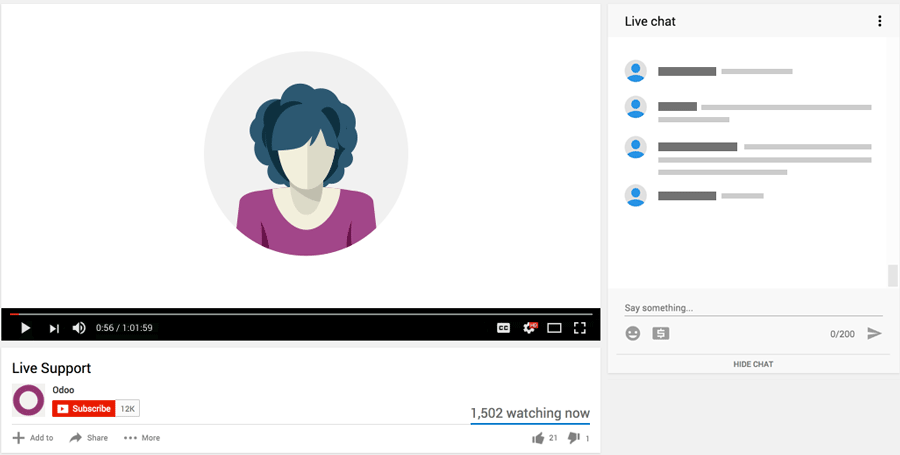
Odoo Experience on YouTube

1. Use the live chat to ask your questions.
2. The operator answers within a few minutes.

Live support on Youtube
Watch now